
Umayyad Caliphate
Second major Islamic caliphate (661–750 CE) founded by the Umayyad dynasty; notable for rapid territorial expansion, administrative reforms, and cultural achievements with lasting legacy in al-Andalus and the Islamic world.
Overview
The Umayyad Caliphate was the second of the principal Islamic caliphates established after the death of the Prophet Muhammad. Emerging from the Meccan clan known as the Banu Umayya, it transformed a regional polity into a sprawling empire whose territory at its height stretched from the Iberian Peninsula to the Indus valley. The dynasty is commonly dated from 661 to 750 CE, when a rival movement replaced it, and a later Umayyad polity continued in Iberia from Córdoba.
Image gallery
10 Images


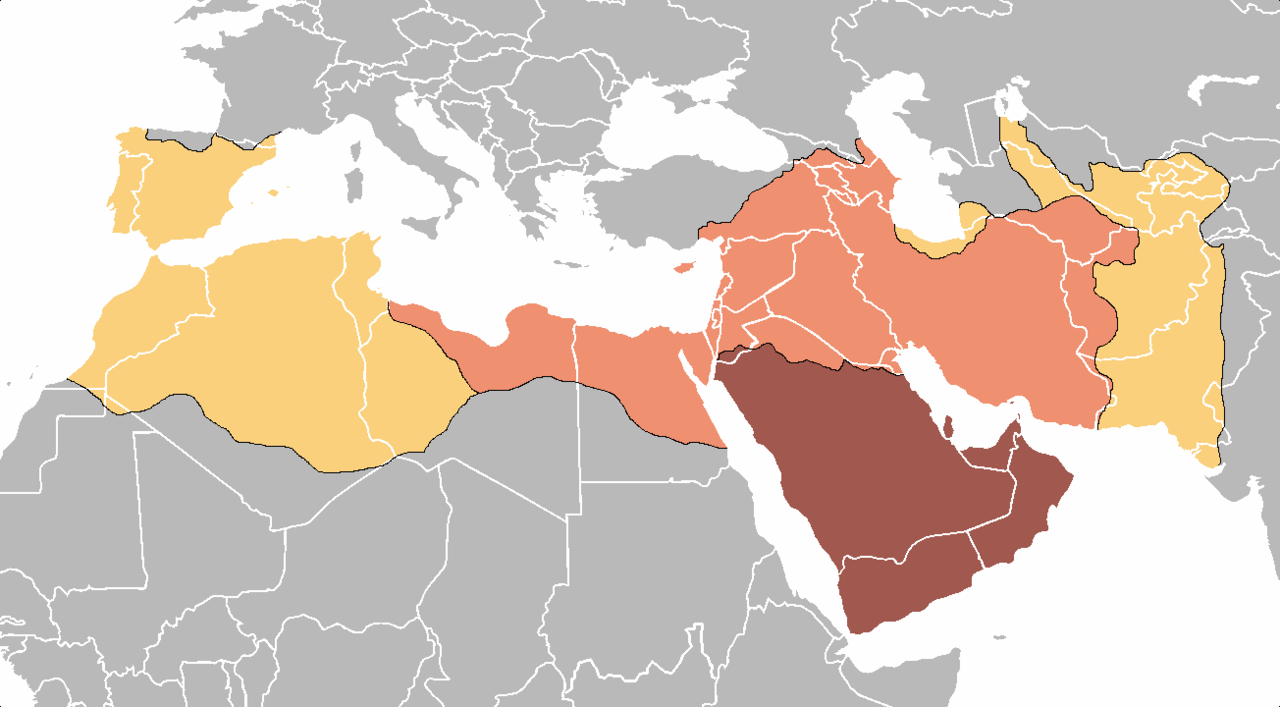
Territory, capitals and rulers
The Umayyad realm became the dominant political power of its age and is often described as one of the largest empires of the early medieval world. Its first capital was established at Damascus, which served as the administrative center for most of the dynasty's rule. In the final years of its eastern control the leadership moved to Harran for a brief period, and after the dynasty's fall a branch of the family set up an enduring court in Córdoba in Iberia.
Administration, language and economy
Umayyad governance introduced more centralized administration to accommodate a vast and diverse population. Arabic increasingly replaced other administrative languages and was promoted in official registers and coinage. Financial and bureaucratic institutions—building on earlier Roman, Byzantine and Sasanian practices—helped manage taxation, military payrolls and provincial governors, enabling long-distance rule across regions now part of modern Saudi Arabia and beyond.
Military expansion and cultural achievements
The period is marked by rapid military campaigns that carried Islamic rule into North Africa and across the Strait of Gibraltar into Iberia. Umayyad patronage encouraged monumental architecture and urban projects: notable surviving works associated with the dynasty include early mosque complexes and the Dome of the Rock and the Great Mosque in Damascus, which reflect new religious, artistic and civic ambitions.
Decline and succession
The Umayyads provoked political and religious opposition, including rival claims from other families and movements. In 750 CE a largely successful uprising replaced Umayyad rule in the east, giving way to a different dynasty while a surviving Umayyad branch preserved authority in al-Andalus. The legacy of that Iberian center influenced medieval Spain and Mediterranean cultural exchanges for centuries.
Significance and notable facts
- The Umayyads consolidated and administered an empire that connected diverse peoples and trade routes across three continents; see broader overviews of the early caliphates here.
- They were drawn originally from Mecca, part of the society of Mecca and its ruling elite.
- Modern studies highlight their role in the Arabicization of administration and in the formation of a distinct early Islamic state identity.
- For introductions to their cultural and political history, consult general resources on early Islamic dynasties and the Umayyad period in Syria and al-Andalus via comparative empire studies and specialized entries on the Banu Umayya.
Questions and answers
Q: What was the Umayyad Caliphate?
A: The Umayyad Caliphate was the second of the four major Islamic caliphates established after the death of Muhammad. It was the largest empire in the world at the time and is considered to be one of the five largest empires in history.
Q: Who ruled over it?
A: The Umayyad Dynasty (Arabic: بنو أمية, Banu Umayyah) ruled over it. They were from Mecca, which is located in present-day Saudi Arabia.
Q: Where was its capital located?
A: Its capital was located in Damascus from 661–744, Harrran from 744–750, and Córdoba (756–1031) when they were in exile.
Q: How long did this caliphate last for?
A: This caliphate lasted for about 370 years until 1031 AD.
Q: What other caliphates existed before this one?
A: Before this caliphate, there were three other major Islamic caliphates that had been established after Muhammad's death - Rashidun Caliphate, Umayyad Caliphate, and Abbasid Caliphate.
Q: What language did they speak during this period? A: During this period, Arabic was primarily spoken by those living within the empire.
Q: What religion did they practice during this period? A: Islam was practiced by those living within the empire during this period.
Related articles
Author
AlegsaOnline.com Umayyad Caliphate Leandro Alegsa
URL: https://en.alegsaonline.com/art/102727