
UDFy-38135539 (HUDF.YD3): candidate high-redshift galaxy
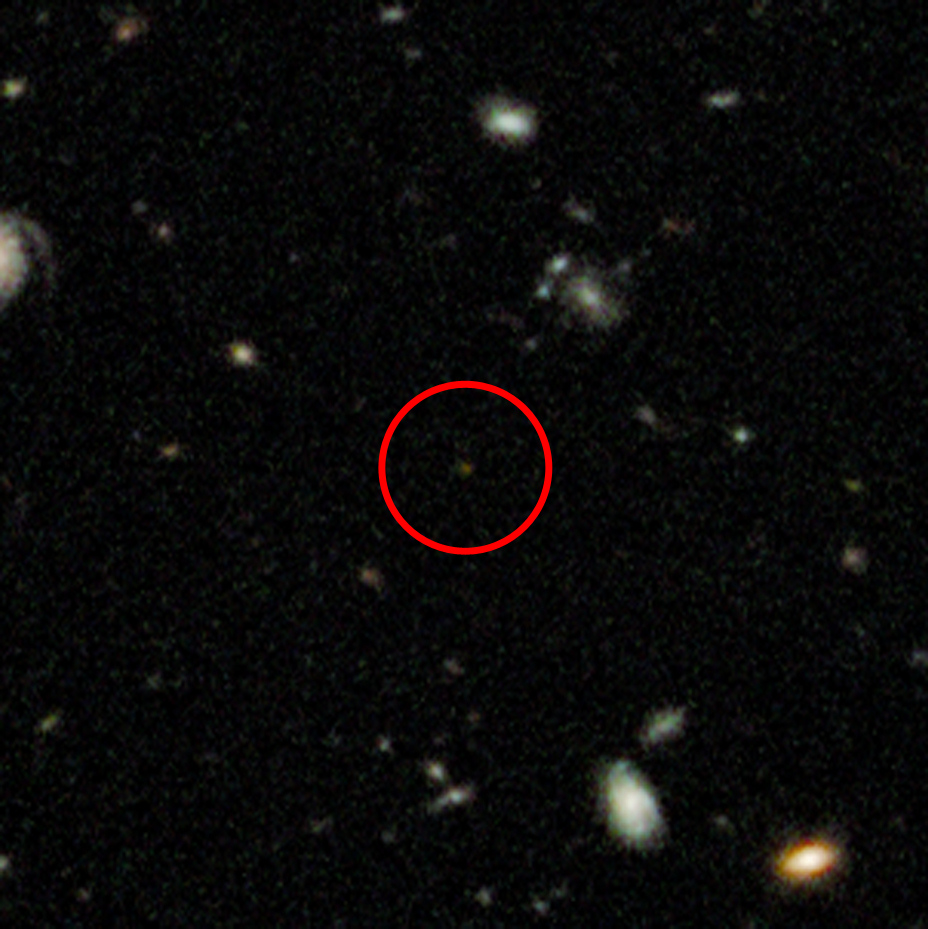
UDFy‑38135539 (HUDF.YD3) is a faint galaxy candidate in the Hubble Ultra Deep Field reported at z≈8.6 (light travel ≈13.1 billion years). Its spectroscopic identification has been debated and remains carefully evaluated.
Overview
UDFy-38135539, catalogued also as HUDF.YD3, is an extremely faint galaxy candidate first identified in deep imaging of the Hubble Ultra Deep Field. It was proposed as one of the earliest known galaxy candidates because its photometric colors and a tentative spectroscopic feature suggested a very high redshift. The object is discussed in the literature as an example of how sensitive imaging and follow-up spectroscopy probe the first few hundred million years after the Big Bang; see general material on distant galaxies.
Image gallery
3 Images

Redshift and distance
Early follow-up work reported a redshift near z≈8.6, which corresponds to light that began its journey roughly 13.1 billion years ago and places the source within the epoch astronomers call the reionization era. This epoch marks the transition of the intergalactic medium from neutral to ionized as the first generations of stars and galaxies formed. The claimed distance and epoch are often summarized in reviews of the Hubble Ultra Deep Field and of observational efforts in the direction of the Fornax region.
Detection and properties
UDFy-38135539 is very faint in visible and near-infrared bands and was detected primarily through deep space-based imaging and careful photometric selection. A weak emission line detected in early ground-based spectroscopy was interpreted as Lyman‑alpha at high redshift; such a line would indicate active star formation and the presence of hot, young stars producing ultraviolet photons. Photometric measurements also suggest a compact, low-mass system typical of early galaxies.
Confirmation and scientific debate
The spectroscopic claim for UDFy-38135539 proved difficult to reproduce: the reported emission line was faint and near the detection limits of the instruments used, so subsequent analyses questioned whether it arose from the target or from noise, sky features, or a lower-redshift interloper. Because of that uncertainty, the object is often described as a candidate high-redshift galaxy rather than an unambiguous, secure spectroscopic detection. The case illustrates broader challenges in confirming extremely distant sources.
Significance
Whether fully confirmed or not, UDFy-38135539 helped motivate deeper surveys and improvements in analysis techniques to study galaxy formation during the first billion years. Candidates like this inform theoretical models of early star formation, feedback, and the timing of reionization, and they help set priorities for future observations with more sensitive facilities.
Further reading
- Survey reports and catalog entries that list HUDF sources and candidate high-redshift objects.
- Summaries of cosmic distances and the relation between redshift and light-travel time.
- Introductory material about deep fields and observational cosmology.
- Reviews of early galaxy candidates and methods used to detect them.
- Technical notes on the Hubble Ultra Deep Field survey and its catalogs.
Questions and answers
Q: What is UDFy-38135539?
A: UDFy-38135539 is a galaxy in the Fornax constellation.
Q: What is special about UDFy-38135539?
A: UDFy-38135539 is the farthest confirmed object ever seen.
Q: How far away is UDFy-38135539 from Earth?
A: UDFy-38135539 is 13.1 billion light years away from Earth.
Q: What is the name of the galaxy also known as UDFy-38135539?
A: UDFy-38135539 is also known as HUDF.YD3.
Q: What is the constellation in which UDFy-38135539 is located?
A: UDFy-38135539 is located in the Fornax constellation.
Q: How does the distance of UDFy-38135539 from Earth compare to other objects in space?
A: UDFy-38135539 is the farthest confirmed object ever seen from Earth.
Q: What does UDFy-38135539 being the farthest confirmed object ever seen mean for astronomers?
A: UDFy-38135539 being the farthest confirmed object ever seen is a significant milestone for astronomers and can provide valuable insights into the early universe.
Author
AlegsaOnline.com UDFy-38135539 (HUDF.YD3): candidate high-redshift galaxy Leandro Alegsa
URL: https://en.alegsaonline.com/art/102509
Sources
- bbc.co.uk : "BBC News - Galaxy is most distant object yet"
- spacetelescope.org : "Hubble finds a new contender for galaxy distance record"
- doi.org : 10.1038/467924a
- pubmed.ncbi.nlm.nih.gov : 20962835
- news.discovery.com : "Oldest object in Universe found"
- haystack.mit.edu : index
- newscientist.com : "Dim galaxy is most distant object yet found"
- content.usatoday.com : "Earliest galaxy helped clear Big Bang's fog"