
United States Postal Abbreviations for States (USPS two‑letter codes)
Overview, history, usage, and a complete list of the two‑letter United States Postal Service abbreviations for all 50 states, with notes on format and related codes.
Overview
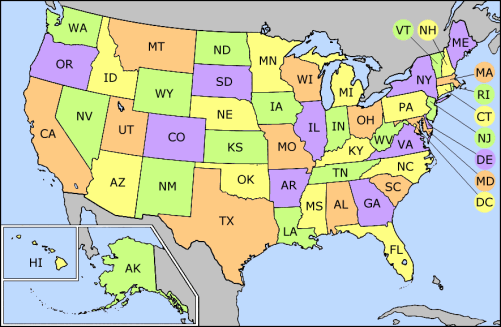
The United States Postal Service (USPS) uses standardized two‑letter abbreviations to represent each U.S. state in mailing addresses and automated sorting systems. These compact, punctuation‑free codes speed processing, reduce address line length and are widely used in databases, forms, maps and legal citations. Although sometimes called "postal codes," they are distinct from ZIP Codes, which identify delivery areas.
Format and common uses
Each state abbreviation consists of two uppercase letters, for example CA for California or NY for New York. The convention deliberately omits periods and longer traditional forms (such as Calif. or N.Y.). USPS abbreviations are used on envelopes, in electronic address fields, on driver's licenses and in many information systems to ensure consistency and compatibility with automated optical recognition and sorting equipment.
History and development
Before the modern two‑letter system, a variety of traditional and postal abbreviations coexisted. In the 1960s, as ZIP Codes and automated mail processing were introduced, the USPS standardized two‑letter codes to make addresses machine‑readable and to fit limited space on mailing labels and forms. Those two‑letter codes later became the de facto standard for many government and private databases and were adopted by international standards bodies when identifying U.S. subdivisions (commonly prefixed by the country code).

States and their two‑letter abbreviations
- Alabama — AL
- Alaska — AK
- Arizona — AZ
- Arkansas — AR
- California — CA
- Colorado — CO
- Connecticut — CT
- Delaware — DE
- Florida — FL
- Georgia — GA
- Hawaii — HI
- Idaho — ID
- Illinois — IL
- Indiana — IN
- Iowa — IA
- Kansas — KS
- Kentucky — KY
- Louisiana — LA
- Maine — ME
- Maryland — MD
- Massachusetts — MA
- Michigan — MI
- Minnesota — MN
- Mississippi — MS
- Missouri — MO
- Montana — MT
- Nebraska — NE
- Nevada — NV
- New Hampshire — NH
- New Jersey — NJ
- New Mexico — NM
- New York — NY
- North Carolina — NC
- North Dakota — ND
- Ohio — OH
- Oklahoma — OK
- Oregon — OR
- Pennsylvania — PA
- Rhode Island — RI
- South Carolina — SC
- South Dakota — SD
- Tennessee — TN
- Texas — TX
- Utah — UT
- Vermont — VT
- Virginia — VA
- Washington — WA
- West Virginia — WV
- Wisconsin — WI
- Wyoming — WY
Notes and distinctions
Although the list above covers the 50 states, USPS also defines two‑letter codes for the District of Columbia (DC), U.S. territories (for example PR for Puerto Rico, GU for Guam) and special military mail destinations (AA, AE, AP). In many contexts—especially international standards and data exchange—the state code is combined with the country code (for example US‑TX). When preparing addresses for mailing, follow USPS guidance for placement, capitalization and ZIP Code use to ensure reliable delivery.
Other codings
Federal District
| Abbreviation | FIPS Code | Area |
| DC | 11 | District of Columbia |
Islands in the Pacific and the Caribbean
| Abbreviation | FIPS Code | Area |
| AS | 60 | |
| GU | 66 | |
| MP | 69 | |
| PR | 72 | |
| VI | 78 | |
| UM | United States Minor Outlying Islands UM is the FIPS code. However, the U.S. Postal Service does not use the term U.S. Minor Outlying Islands because mail to these islands is delivered via other territories (PR, HI, AA or AP). |
Freely Associated States
| Abbreviation | FIPS Code | Area |
| FM | 64 | |
| MH | 68 | |
| PW | 70 |
U.S. Military Mail
| Abbreviation | FIPS Code | Area |
| AA | Armed Forces Americas (except Canada) | |
| AE | Armed Forces EuropeArmed Forces | |
| AP | Armed Forces Pacific |
Older, now invalid codes
| Abbreviation | FIPS Code | Area |
| CM | Commonwealth of the Northern Mariana Islands 1988 changed to MP | |
| CZ | ||
| TT | Trust Territory of the Pacific Islands | |
| PI |
Addressing example
JOHN DOE359
OAK LANEGIBBSBORO
, NJ 08026
See also
- ZIP Code (Postal Codes of the USA)
- ISO 3166-2 Code
- Postal abbreviations for provinces and territories of Canada
Related articles
Author
AlegsaOnline.com United States Postal Abbreviations for States (USPS two‑letter codes) Leandro Alegsa
URL: https://en.alegsaonline.com/art/102416
Sources
- pe.usps.gov : Publication 28 - Postal Addressing Standards.