
Tunguska event: 1908 Siberian airburst
A massive mid‑air explosion above central Siberia on 30 June 1908 that flattened forest over thousands of square kilometres; now interpreted as an airburst of a cosmic body and central to planetary‑defense studies.
Overview
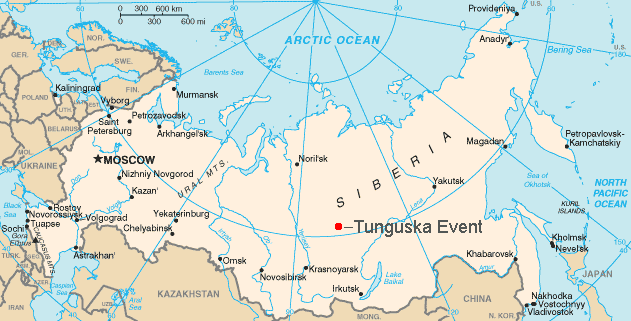
The Tunguska event refers to a powerful explosion that occurred on the morning of 30 June 1908 in a sparsely populated region of central Siberia, near the Podkamennaya Tunguska River. Most contemporaneous reports place the main disturbance at about 7:15 a.m. local time. Rather than producing a conventional impact crater, the event flattened and scorched trees across a large area and was witnessed as a bright fireball and a series of detonations by inhabitants and travellers in the region.
Image gallery
10 Images





Evidence and observed effects
Eyewitnesses described a bright object crossing the sky, loud explosions, and a shock wave. Many of these eyewitness accounts came from native Evenks and Russian settlers within a range of tens to hundreds of kilometres. The most striking physical evidence is the radial pattern of felled trees around the epicentral area: about 2,150 km2 of forest was flattened in a pattern that radiates outward from a central point, with trees near the center scorched and laid out in a butterfly-shaped pattern further out. Windows and doors in settlements many tens of kilometres away were reported broken, and nocturnal skies over Europe and Asia showed unusual luminosity for several nights afterward.
Seismology, infrasound and atmospheric records
Contemporaneous instruments recorded disturbances at great distances: seismic stations registered waves, and barometers and infrasound detectors (some of which were primitive by modern standards) registered pressure pulses that propagated around the globe. These seismic and atmospheric records helped establish the time and approximate energy of the event and confirmed that the disturbance was of atmospheric origin rather than a local geological explosion.
Leading interpretations and hypotheses
No conventional impact crater has been identified, which led researchers to favour an airburst scenario: a cosmic object — most likely a stony asteroid or a fragment of a comet — entered Earth’s atmosphere and exploded at altitude, releasing energy that shattered the incoming body and produced a shock wave intense enough to flatten trees and damage structures. Estimates of the burst altitude commonly fall in the range of about 7 to 15 kilometres above ground. Over the years a variety of alternative ideas have been proposed, including rare geophysical or exotic explanations, but the airburst interpretation is the consensus within mainstream planetary science.
Investigations and historical context
Because the impact zone was remote, scientific investigation did not begin until decades after the event. The first major expedition was led by Russian mineralogist Leonid Kulik in the late 1920s and 1930s; Kulik documented tree fall patterns and collected testimonies but did not find a crater. Subsequent fieldwork, laboratory analysis, and computer modelling through the 20th and 21st centuries refined estimates of the energy released and the likely nature of the incoming body.
Importance and modern parallels
Tunguska remains the largest well‑documented atmospheric explosion in recorded history and is a touchstone for studies of near‑Earth objects and planetary defence. Its approximate scale has been compared with more recent events such as the 2013 Chelyabinsk airburst, which demonstrated how relatively small cosmic fragments can produce widespread damage and injuries on populated ground. The Tunguska event underscores the hazard posed by objects tens of metres across and motivates continued observation and mitigation planning for near‑Earth asteroids and cometary fragments.
Key facts
- Date: 30 June 1908, early morning.
- Location: sparsely inhabited taiga near the Podkamennaya Tunguska River in central Siberia.
- Effects: extensive tree fall over ~2,150 km2, bright sky reports at great distance, seismic and atmospheric disturbances.
- Most likely cause: an atmospheric airburst of a small asteroid or comet fragment; no confirmed impact crater.
Questions and answers
Q: What is the Tunguska event?
A: The Tunguska event is a very large mid-air explosion that occurred on 30 June 1908 in Siberia.
Q: What time did the explosions happen?
A: The explosions happened around 7:15 a.m. local time.
Q: What is the cause of the Tunguska event?
A: The cause of the Tunguska event is unknown, but a meteorite impact has been suggested as a likely cause.
Q: What happened in Wanwara, a small settlement, about 65 km (40 mi) away?
A: In Wanwara, windows and doors were smashed.
Q: How many people died as a result of the Tunguska event?
A: There are no reports of people who have died. Depending on the source, there were one or two casualties.
Q: How far away was the bright light seen after the Tunguska event occurred?
A: Over 500 km (311 mi) away, bright light was seen, and an earthquake was felt.
Q: When did the Tunguska event happen and at what height above ground?
A: The Tunguska event happened about 7 to 15 km (4.3 to 9.3 mi) above ground, at 0:14 UTC (7:14 a.m. local time).
Related articles
Author
AlegsaOnline.com Tunguska event: 1908 Siberian airburst Leandro Alegsa
URL: https://en.alegsaonline.com/art/102024
Sources
- articles.adsabs.harvard.edu : Human Casualties in Impact Events
- www-th.bo.infn.it : Geophysical/sedimentological study of a lake close to the epicenter of the great 1908 Siberian (Tunguska) Explosion
- news.nationalgeographic.com : "Crater from 1908 Russian Space Impact Found, Team Says"