
Trust (social science)
A concise encyclopedia entry on trust: definitions, types, psychological and social components, historical development, measurement approaches, and its role in relationships, institutions, and society.
Overview
Trust is a fundamental social feeling and decision: the expectation that a person, group, system or institution will act in a reliable, competent or benevolent way. In everyday language it appears as both a noun and a verb. The lexical forms are illustrated by simple contrasts: as a noun ("I have trust in her"), as a verb ("I trust her"), and as an adjective ("he is trusting"). Across disciplines, scholars separate trust as an attitude, a choice, and a set of behavioral expectations that reduce the perceived risk of dependence on others.
Image gallery
2 Images
Key characteristics and components
Researchers often describe trust through a few recurring dimensions. A common tripartite framework identifies:
- Ability — the perceived competence to perform a task;
- Benevolence — the belief that the trustee cares about the trustor’s interests;
- Integrity — the expectation that the trustee adheres to acceptable principles or promises.
Trust reduces complexity in social life by allowing people to rely on reputations, institutions, norms, or contracts rather than constantly verifying behavior. It coexists with strategies such as monitoring and sanctions; when trust is low, systems rely more on formal controls.
Types and measurement
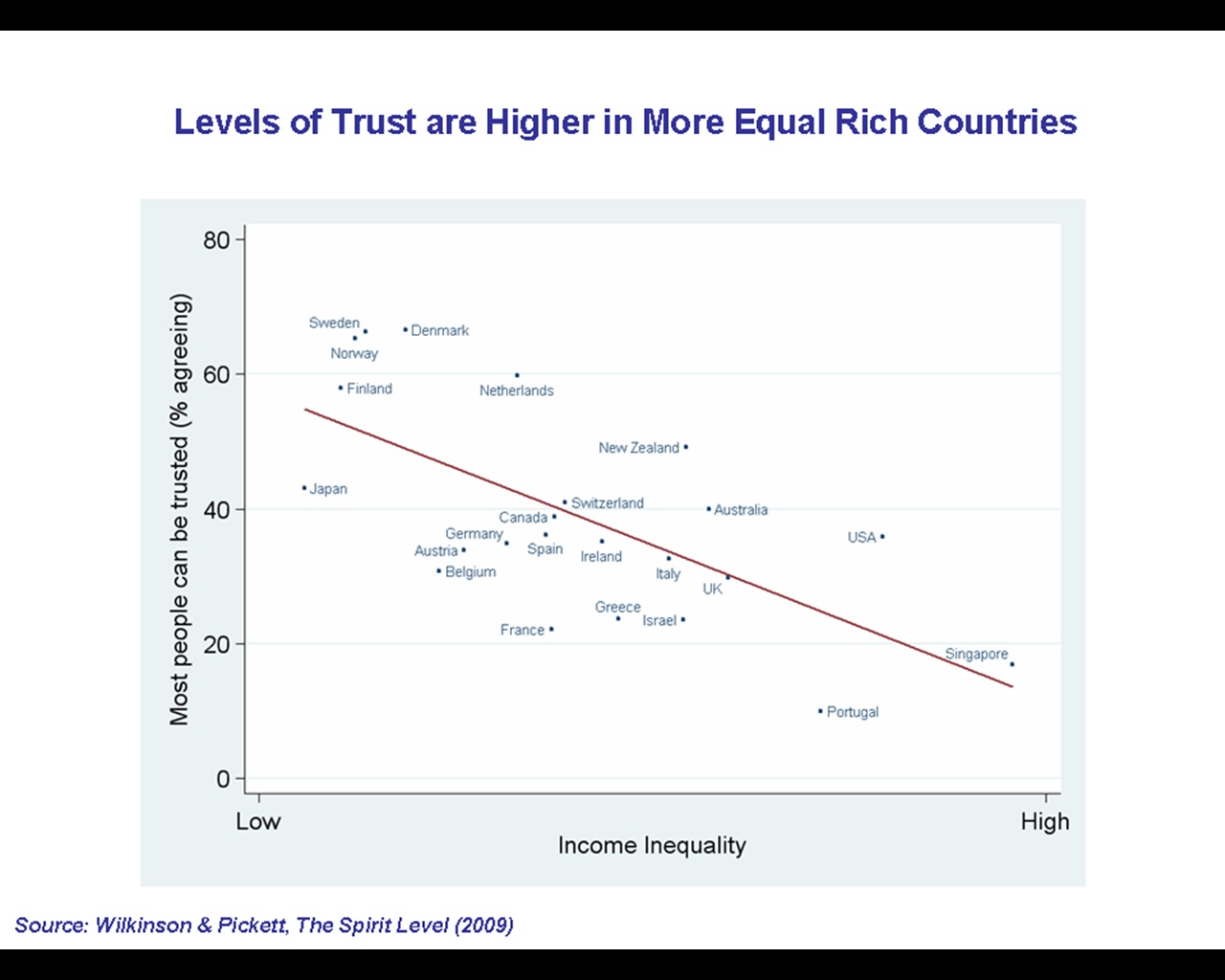
Scholars distinguish interpersonal trust (between individuals), institutional trust (in organizations or government), and generalized trust (a broad willingness to trust strangers). Measurement techniques range from survey questions about whether "most people can be trusted" to behavioral tasks in laboratories and field experiments like trust games. Social scientists complement self-reports with observational and experimental methods to assess how trust forms, persists, or erodes.
History and development
Concepts of trust have roots in philosophy, theology and early social thought; religious traditions treat trust as faith or reliance, for example the idea of placing trust in a deity appears in many scriptures and devotional texts, as reflected in phrases such as "trust in God" or devotional exhortations. Contemporary study of trust emerged with modern sociology, psychology, and economics, which formalized trust as a variable that affects cooperation, markets, and institutional legitimacy.
Functions, examples and importance
Trust matters in everyday life and large-scale systems. In personal relationships it enables vulnerability and cooperation; in business it lowers transaction costs; in politics it underpins compliance and democratic legitimacy. Institutions build trust through transparency, accountability and consistent performance. Examples include trusting a friend to keep a confidence, trusting a bank with savings, or trusting public health advice during an epidemic.
Breakdown, repair and notable distinctions
When trust is violated, repair involves acknowledgment, restitution, and predictable behavior over time. Distinctions often highlighted are trust versus reliance (predictable behavior without moral judgment), and trust versus faith (which can imply belief without evidence). Religious uses of trust sometimes overlap with faith and are discussed separately in theological literature; see links for language forms and religious contexts: religion, God, Proverbs, LORD.
Understanding trust helps explain cooperation, social capital, and institutional stability. Its study spans multiple fields and methods, combining conceptual analysis with empirical research to clarify how trust emerges, how it is measured, and how societies maintain or rebuild it after breaches.
Questions and answers
Q: What is trust?
A: Trust is the feeling of being sure about somebody or something, even if it cannot be proved, that they can be relied upon, or will turn out to be good.
Q: Can trust be a noun?
A: Yes, trust can be a noun. For example, "I have complete trust in you."
Q: Can trust be a verb?
A: Yes, trust can be a verb. For example, "I trust you completely."
Q: What is the meaning of the adjective "trusting"?
A: The adjective "trusting" means easily trusting people.
Q: Can one trust a thing?
A: Yes, one can trust a thing. For example, "I would not trust that chair."
Q: What does it mean to trust in religion?
A: In religion, trust can be similar to faith. Someone who believes in God will put their trust in Him.
Q: In what other ways can trust be used?
A: To trust (or entrust) can be used in other ways.
Related articles
Author
AlegsaOnline.com Trust (social science) Leandro Alegsa
URL: https://en.alegsaonline.com/art/101830