
Trogons and quetzals (Family Trogonidae)
Trogons are colorful tropical birds of the family Trogonidae. This article summarizes their appearance, anatomy, behaviour, distribution, fossil history, nesting, taxonomy, conservation and cultural importance.
Overview
Trogons and quetzals form a distinctive family of mostly tropical birds, the Trogonidae, and are the only family in the order Trogoniformes. The family includes dozens of species placed in several genera and is best known for soft, often brightly coloured plumage, long tails in some species, and quiet, sit-and-wait behaviour. Fossils indicate an ancient lineage, with records dating back to the Eocene period and specifically the mid-Eocene in age. The common name derives from Greek and refers to the birds' habit of gnawing nest cavities (name origin).
Image gallery
10 Images

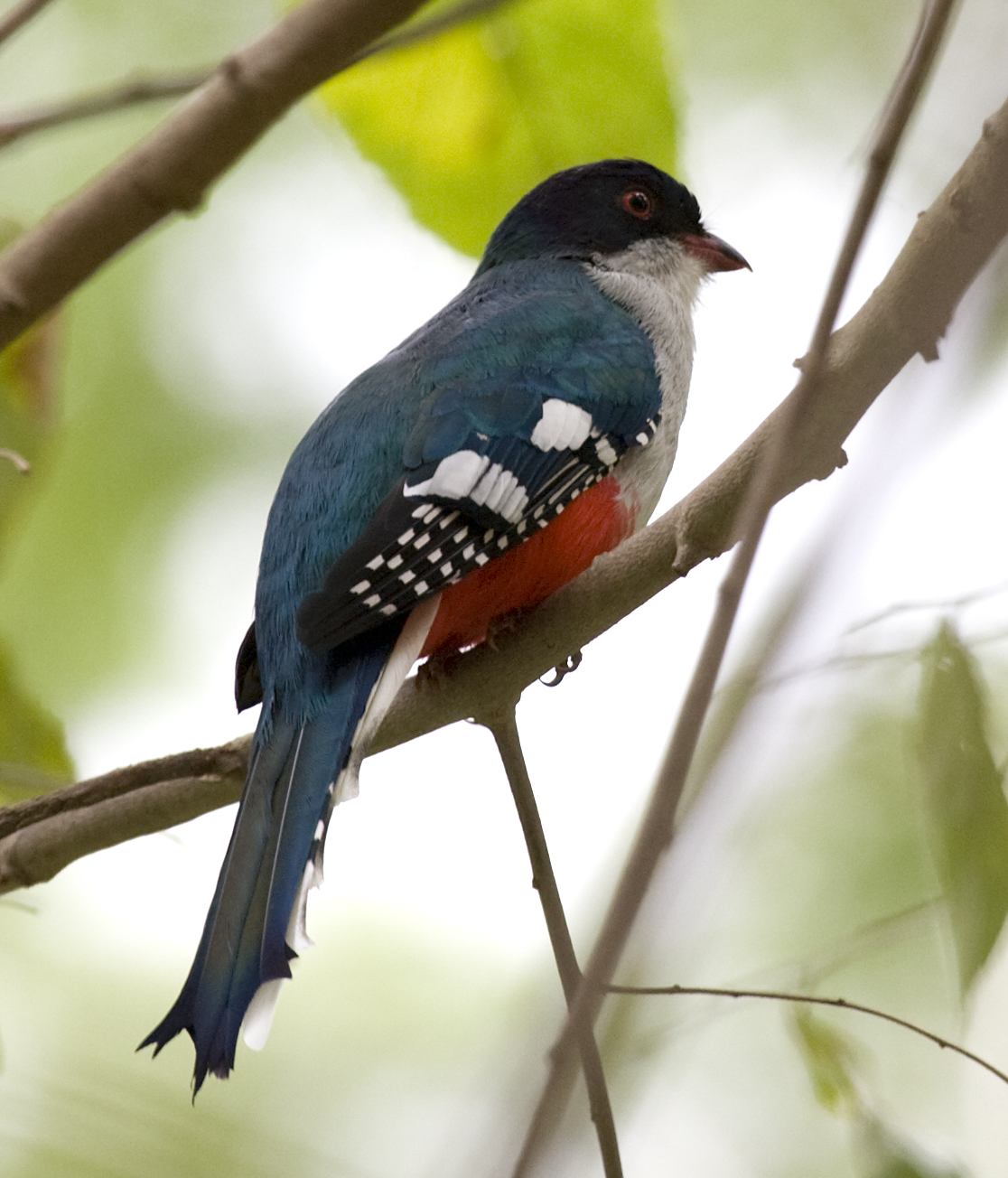


Appearance and anatomy
Trogons are small to medium-sized birds with compact bodies, short necks and relatively broad bills. Many species show strong sexual dimorphism: males often have brighter colours and more iridescence while females are plainer. Their feathers are soft and plush-like rather than stiff. A notable anatomical feature is the heterodactyl foot arrangement—unique among birds—where toes one and two point backward and toes three and four forward; this is often discussed in overviews of their unique foot anatomy. Legs are weak and adapted for perching rather than walking.
Distribution and habitat
Trogons occur in tropical and subtropical forests across three main regions. The greatest species richness is in the Neotropics, where multiple genera and many species occupy lowland and montane forests and cloud forests. Asia supports several genera, including the Southeast Asian groups often treated under genera such as Apalharpactes and Harpactes, while Africa hosts a small contingent represented by the genus Apaloderma. Their preferred habitats are forest interior, forest edges and dense secondary growth, often near clearings and streams.
Feeding and behaviour
Trogons are primarily insectivorous and frugivorous. They typically perch silently in shaded branches and sally out to snatch insects in flight or pluck fruit and return to the perch. Their broad bills assist in handling fruits and larger arthropods; many species play a role in seed dispersal and fruit ecology (fruit interactions). They are generally sedentary, with most species resident year-round, although a few show local altitudinal movements rather than long-distance migration (residency patterns). Arboreal habits and weak legs reflect their tree-dwelling adaptations.
Reproduction and nesting
Trogons nest in cavities that they excavate themselves in decayed wood or in active or abandoned termite nests. The excavation habit connects to the etymology of the group and is a repeated behavioural theme in accounts of their natural history (name origin and nesting). Clutch sizes are typically two to four eggs, often white or pale, and both parents commonly participate in incubation and feeding. Nest site selection is important for breeding success and species that require large trees or intact forest structure can be vulnerable to habitat change.
Taxonomy and evolution
The single-family order Trogoniformes contains the family Trogonidae, with roughly thirty to forty living species placed in several accepted genera. Fossil finds from the paleontological record and molecular studies have helped clarify relationships, but some taxonomic points and genus-level limits remain under review. The family’s long fossil history in the Eocene underlines its deep evolutionary roots among modern birds.
Conservation and human significance
Many trogon species depend on mature forest habitats and face threats from deforestation, fragmentation and habitat degradation. Species with small ranges, specialized habitats or dependence on older-growth forest are particularly at risk. Quetzals of Central America have strong cultural importance and feature in indigenous mythology and modern national symbolism; they also attract ecotourism and birdwatching interest (Neotropical diversity and cultural value). Conservation measures typically involve habitat protection, restoration and research on population trends.
- Family: Trogonidae
- Order: Trogoniformes
- Heterodactyl foot anatomy
- Asian genera reference
- Fossil record
- Mid-Eocene context
- Etymology and nesting behaviour
- Neotropical diversity and quetzals
- African representatives
- Feeding and foraging summaries
- Fruit and seed interactions
- Arboreal adaptations
- Migration and residency
Questions and answers
Q: What order are the trogons and quetzals birds in?
A: The trogons and quetzals are birds in the order Trogoniformes.
Q: How many living species of trogons are there?
A: There are 39 living species of trogons.
Q: What is the significance of the word "trogon"?
A: The word "trogon" is Greek for "nibbling" and refers to the fact that these birds gnaw holes in trees to make their nests.
Q: In which part of the world do trogons have the greatest diversity?
A: Trogons have the greatest diversity in the Neotropics, where four genera, with 24 species occur.
Q: What is the diet of trogons?
A: Trogons feed on insects and fruit.
Q: How do trogons nest?
A: Trogons nest in holes dug into trees or termite nests, laying 2–4 white or pastel-coloured eggs.
Q: What is unique about trogons' feather arrangements?
A: They have soft, often colourful, feathers with distinctive male and female plumage. They are the only type of animal with a heterodactyl toe arrangement.
Related articles
Author
AlegsaOnline.com Trogons and quetzals (Family Trogonidae) Leandro Alegsa
URL: https://en.alegsaonline.com/art/101609