
Triceratops — the three-horned Late Cretaceous ceratopsian
Large, horned herbivore of Late Cretaceous North America, noted for three facial horns, a massive skull and frill, abundant fossils across Hell Creek and other formations, and ongoing study of growth and function.
Overview
Triceratops is a well-known genus of large, horned herbivorous dinosaur from the last part of the Cretaceous. It is a member of the broader ceratopsid family and is one of the best-known representatives among horned dinosaurs. The genus is mainly recorded from western North America, where numerous skulls and skeletons have been collected from late Cretaceous rocks.
Image gallery
10 Images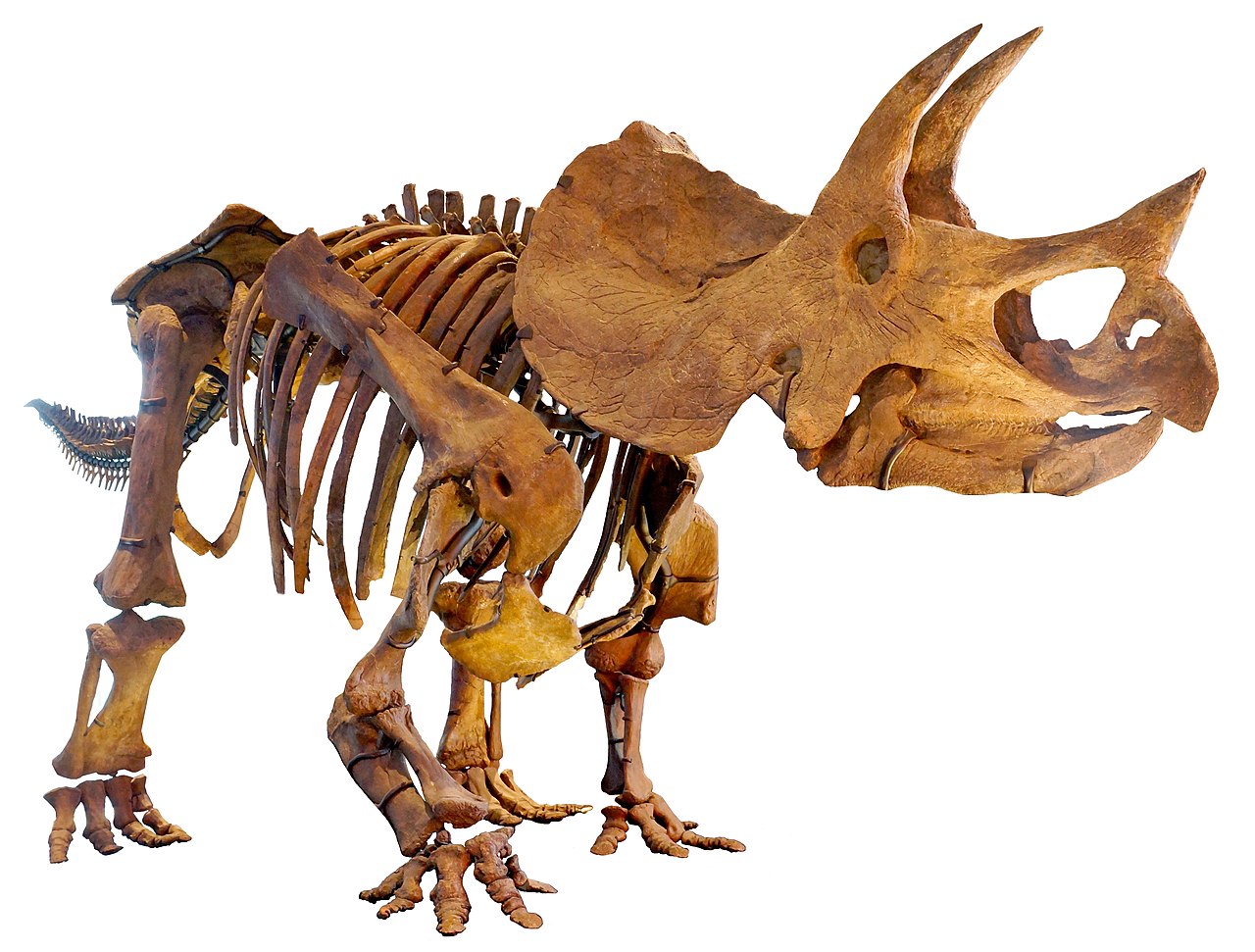
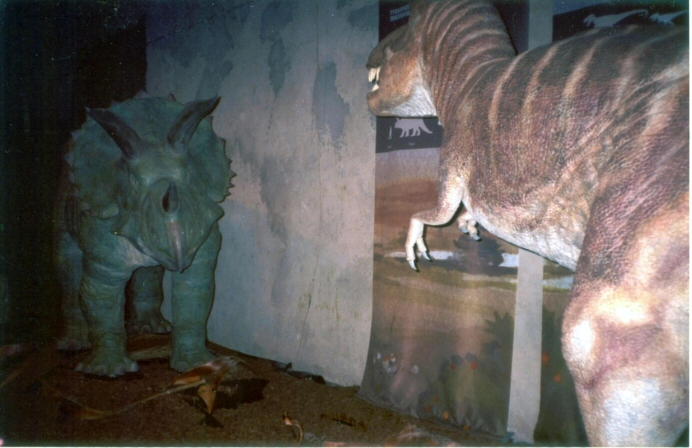




Physical characteristics
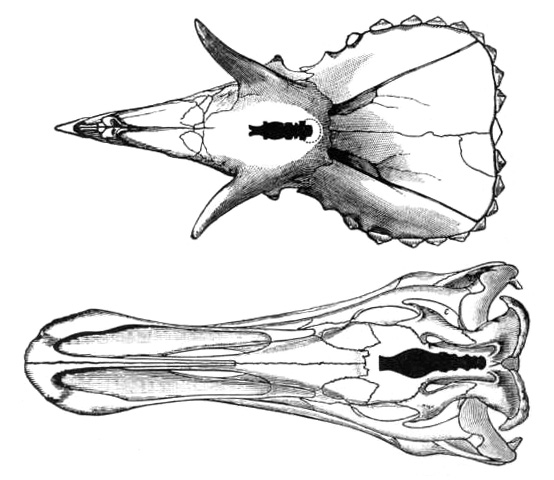
Adult Triceratops had a distinctive head: two long brow horns over the eyes, a shorter nasal horn, and a wide bony frill at the rear of the skull. The skull could exceed two metres in length, making it one of the largest skulls of any land animal. The front of the jaws bore a horny, parrot-like beak used to crop vegetation, while dental batteries of closely packed teeth in the cheeks ground plant material. Overall body length is commonly reported up to about nine metres, with a heavy, barrel-shaped torso and sturdy limbs to support a large gut.
Feeding and ecology
Triceratops was primarily a low browser that fed on fibrous plants, employing its beak to grasp and its tooth batteries to slice and grind vegetation. Studies of jaw mechanics and wear patterns suggest efficient cropping and chewing of tough plant matter; for more on functional studies see feeding and jaw mechanics. It lived in ecosystems that included diverse herbivores and large theropod predators, and its horns and frill likely served multiple roles including defence, display, and species recognition.
Predation, injuries and pathologies
Fossils show healed wounds and puncture marks on frills and other bones consistent with interactions with large predators and with conspecific combat. Some injuries appear on the sacrum and pelvic region, indicating both predator attacks and intraspecific behaviours. Careful study of bone lesions and healed fractures provides insight into life history and behaviour.
Fossil record and discovery
The genus was first named in the late 19th century and has since become one of the most commonly collected large dinosaurs in certain formations. Field sites such as the Hell Creek Formation are especially rich in Triceratops material; many specimens of varying sizes have been recovered there. Museums hold multiple near-complete skeletons and dozens of skulls, and specimens representing growth stages from juvenile to adult have allowed researchers to document ontogenetic change in horns and frill.
Growth, variation and taxonomy
Because Triceratops is represented by many skulls of different sizes, it has been central to studies of dinosaur growth (ontogeny). Variation in frill shape and horn proportions has led to discussion about how many species or genera are represented in the fossil record. Notably, comparisons involving the genus Torosaurus sparked debate over whether some specimens represent an older growth stage of Triceratops or a distinct genus; this remains an active topic among specialists. For general taxonomic listings see genus records.
Research and public interest
Ongoing research combines field collecting, anatomical study, histology (bone microstructure), and biomechanical analysis to refine understanding of Triceratops biology. Popular displays and educational resources in museums often present Triceratops as an emblematic Late Cretaceous animal; further context on regional fauna and geology can be found through resources on regional faunal lists, specimen photos, and formation maps. For anatomical topics, see summaries of pelvic structure at pelvic structure and additional regional or lineage discussions at ceratopsid lineage.
- Distinctive features: three facial horns and a broad frill.
- Size: skulls commonly exceed two metres; adults reached several metres in length.
- Significance: abundant fossils make Triceratops important for studies of growth, behaviour and Late Cretaceous ecosystems.
For deeper study, consult museum specimen catalogs, regional geological reports, and peer-reviewed reviews of ceratopsid evolution and functional anatomy. Fieldwork reports and regional formation guides remain primary sources for contextual information about localities and stratigraphy.
Questions and answers
Q: What was Triceratops?
A: Triceratops was a herbivorous ceratopsid dinosaur from the late Cretaceous with three horns on its head.
Q: Where were Triceratops mainly found?
A: Triceratops were mainly found in North America.
Q: What was the size of a fully-grown Triceratops?
A: A fully-grown Triceratops could grow up to 9 meters long by 3 meters tall and weigh around 12 tonnes.
Q: What was Triceratops' main defense mechanism?
A: Triceratops had a bony shield covering its neck to defend against attacks from taller theropods.
Q: How many complete or partial skulls were discovered in the Hell Creek Formation from 2000-2010?
A: Forty-seven complete or partial skulls were discovered in the Hell Creek Formation from 2000-2010.
Q: What did Triceratops use to eat?
A: Triceratops used a bony beak in front of its jaws and close-set grinding teeth to eat.
Q: Have life stages from hatchling to adult been found in Triceratops fossils?
A: Yes, specimens showing life stages from hatchling to adult have been found in Triceratops fossils.
Related articles
Author
AlegsaOnline.com Triceratops — the three-horned Late Cretaceous ceratopsian Leandro Alegsa
URL: https://en.alegsaonline.com/art/101471
Sources
- doi.org : 10.1671/039.029.0406
- newscientist.com : "Morph-osaurs: how shape-shifting dinosaurs deceived us - life - 28 July 2010"
- doi.org : 10.1080/02724634.2010.483632
- dinodictionary.com : "T Dinosaurs Page 2"
- internt.nhm.ac.uk : "Triceratops in the Natural History Museum's Dino Directory"
- doi.org : 10.1111/j.1096-3642.1985.tb00871.x
- gspauldino.com : "Limb bone scaling, limb proportions, and bone strength in neoceratopsian dinosaurs"
- palaeo-electronica.org : "Forelimb stance and step cycle in Chasmosaurus irvinensis (Dinosauria: Neoceratopsia)"
- cnn.com : Triceratops trio unearthed in Wyoming
- jstor.org : jstor.org/discover/10.2307/2406631?uid=3738032&uid=2&uid=4&sid=21104087527023
- nhm.ac.uk : "Horn use in Triceratops (Dinosauria: Ceratopsidae): testing behavioral hypotheses using scale models"
- doi.org : 10.1038/275441a0
- pubmed.ncbi.nlm.nih.gov : 692723
- doi.org : 10.1126/science.192.4244.1123
- pubmed.ncbi.nlm.nih.gov : 17748675