
Begoniaceae — the begonia family of flowering plants
Begoniaceae is a pantropical family dominated by the genus Begonia, known for asymmetric leaves and showy unisexual flowers; many species are cultivated as ornamentals and some are conservation priorities.
Overview
The Begoniaceae are a family of flowering plants noted for their diversity and horticultural importance. The family is largely tropical and subtropical in distribution: it occurs across the subtropics and tropics of both the New World and the Old World. Botanists estimate about 1,400–1,500 species, and almost all of them belong to a single large genus, Begonia (Begonia sensu lato). The family entry in many plant databases is summarized under a general family account.
Image gallery
10 Images




Taxonomy and genera
Begoniaceae contains two recognized genera. The genus Begonia comprises the vast majority of species. A single, much smaller genus, Hillebrandia, is monotypic and endemic to the Hawaiian Islands. All but one of the family's species belong to Begonia, a pattern that makes Begoniaceae unusual because one genus dominates the family's diversity (see note).
Characteristics
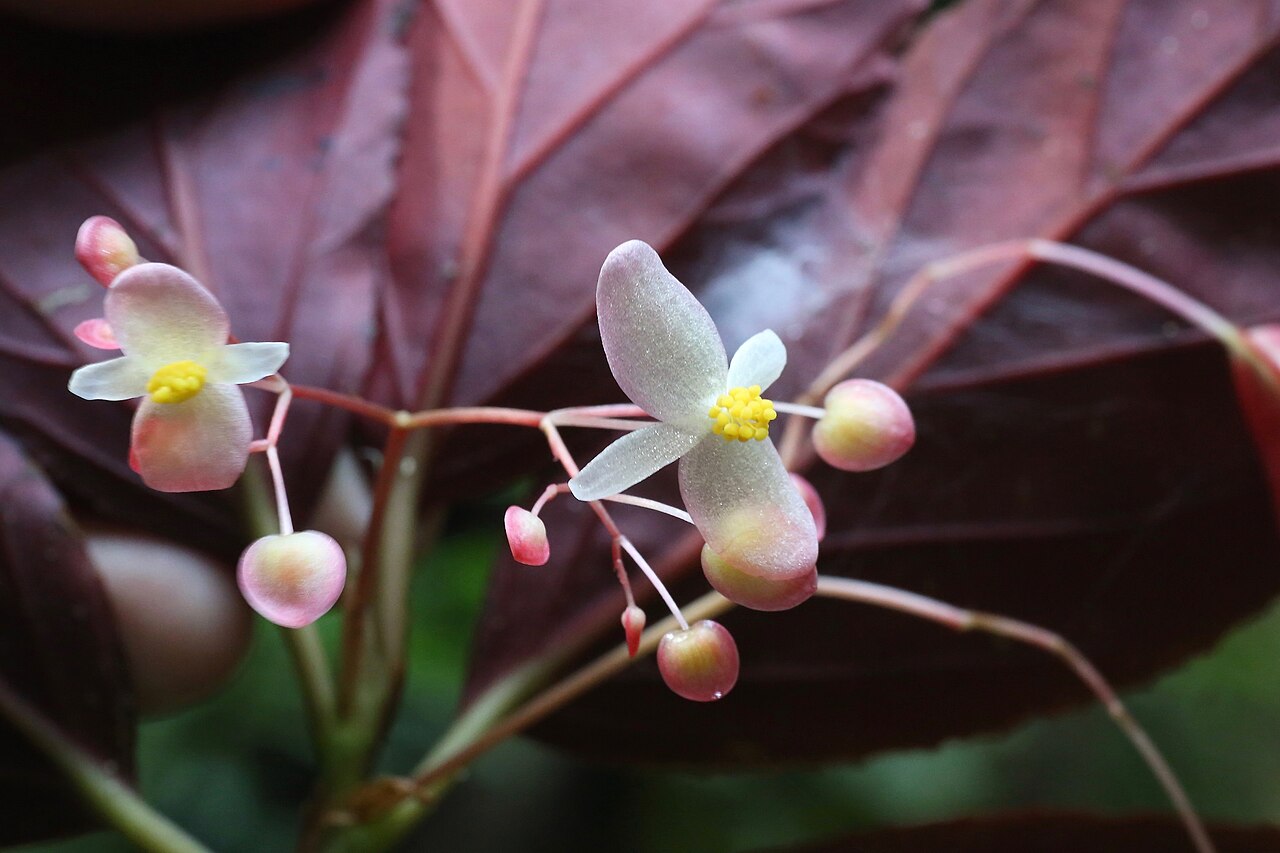
Members of Begoniaceae are mostly perennial herbs, shrubs, or climbers and often show striking foliage. A common diagnostic feature is leaf asymmetry: many species have leaves with noticeably unequal halves where the petiole attaches. Flowers are unisexual (male and female flowers occur on the same plant in most species), usually with a small number of petal-like tepals, and the fruit is typically a winged capsule or, less commonly, berry-like. Chromosome numbers and growth habits vary widely across the family.
Uses, cultivation and popular groups
Begonias are widely cultivated for ornamental use. Numerous varieties, named cultivars and hybrids are available, bred for leaf color and pattern, flower display, or suitability as houseplants. Common horticultural groups include tuberous begonias, rex (fancy-leaved) begonias, cane-stem types, rhizomatous forms and wax begonias. General care emphasizes bright, indirect light, moderate humidity and well-draining soil; however, requirements differ among groups.
Distribution, ecology and conservation
Begoniaceae species occupy shaded understories, rocky crevices and moist habitats across tropical and subtropical regions. Many species are narrowly endemic or restricted to specialized habitats, which makes some vulnerable to habitat loss and fragmentation. Conservation assessments have identified threatened species in several regions; ex situ cultivation in botanical gardens plays a role in preserving genetic diversity.
History and notable facts
- Historical naming: the genus Begonia was named by early botanical explorers and carries a horticultural legacy in Europe and Asia.
- Horticultural importance: begonias rank among the most popular ornamental plants worldwide, used in bedding, containers and indoor collections.
- Scientific interest: the family attracts study for its leaf morphology, reproductive biology and rapid speciation in some areas.
- Further reading and resources are available through general plant references and specialist databases (family resources, regional floras).
For practical guides on growing and identifying common types, consult horticultural manuals and local botanical garden publications (regional guidance, species lists). Specialist articles and conservation data can be found through botanical institutions and plant conservation groups (taxonomic treatments, cultivar registries, grower resources, hybrid records). Additional general overviews and images are available in online plant collections (tropical floras, subtropical references, endemic genus account, Hawaiian flora notes).
Questions and answers
Q: What is the Begoniaceae family?
A: The Begoniaceae family is a family of flowering plants with about 1400-1500 species occurring in the subtropics and tropics of both the New World and Old World.
Q: What is the genus of all but one species in the Begoniaceae family?
A: The genus of all but one species in the Begoniaceae family is Begonia.
Q: Which is the only other genus in the Begoniaceae family?
A: The only other genus in the Begoniaceae family is Hillebrandia.
Q: What is the distribution of the Begoniaceae family's species?
A: The Begoniaceae family's species occur in the subtropics and tropics of both the New World and Old World.
Q: How many species are in the Begoniaceae family?
A: The Begoniaceae family has about 1400-1500 species.
Q: Where is the genus Hillebrandia endemic to?
A: The genus Hillebrandia is endemic to the Hawaiian Islands.
Q: What are some uses of varieties and hybrids of the genus Begonia?
A: Varieties and hybrids of the genus Begonia are used as ornamental plants.
Tags
Related articles
Author
AlegsaOnline.com Begoniaceae — the begonia family of flowering plants Leandro Alegsa
URL: https://en.alegsaonline.com/art/10125
Sources
- wayback.archive-it.org : "An update of the Angiosperm Phylogeny Group classification for the orders and families of flowering plants: APG III"
- doi.org : 10.1111/j.1095-8339.2009.00996.x
- www3.interscience.wiley.com : www3.interscience.wiley.com/journal/122630309/abstract
- efloras.org : "Begoniaceae in Flora of China"
- zimbabweflora.co.zw : "Begoniaceae - Begonia family"
- delta-intkey.com : "Begoniaceae C.A. Agardh"
- biodiversitylibrary.org : "Aphorismi Botanici"
- rbge.org.uk : "A phylogeny of Begonia using nuclear ribosomal sequence data and non-molecular characters"
- amjbot.org : "Phylogenetic position and biogeography of Hillebrandia sandwicensis (Begoniaceae): a rare Hawaiian relict"
- tropicos.org : "Begoniaceae C. Agardh in Flora of Pakistan"