
Trapezius muscle — anatomy, function, and clinical relevance
Large superficial back muscle that shapes the upper back and neck. Covers anatomy, divisions, actions on the scapula and arm, innervation, clinical issues, rehabilitation and historical notes.
The trapezius is a broad, flat muscle on the upper back and neck that plays a central role in shoulder and neck movement. In studies of human anatomy it is classed as a superficial back muscle spanning from the base of the skull to the mid‑thoracic spine. Its position and size make it important for posture, elevation and rotation of the shoulder girdle, and for stabilizing the shoulder during arm movements.
Image gallery
9 Images

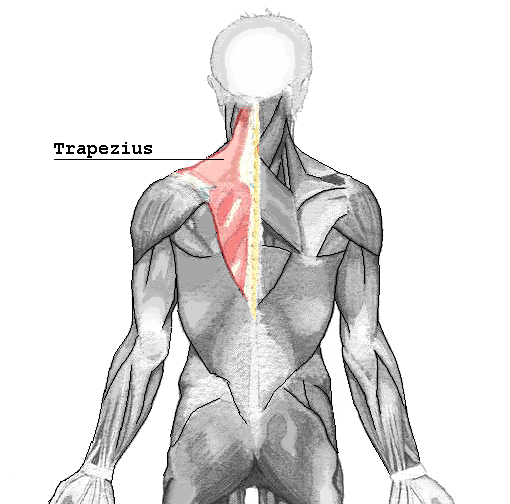


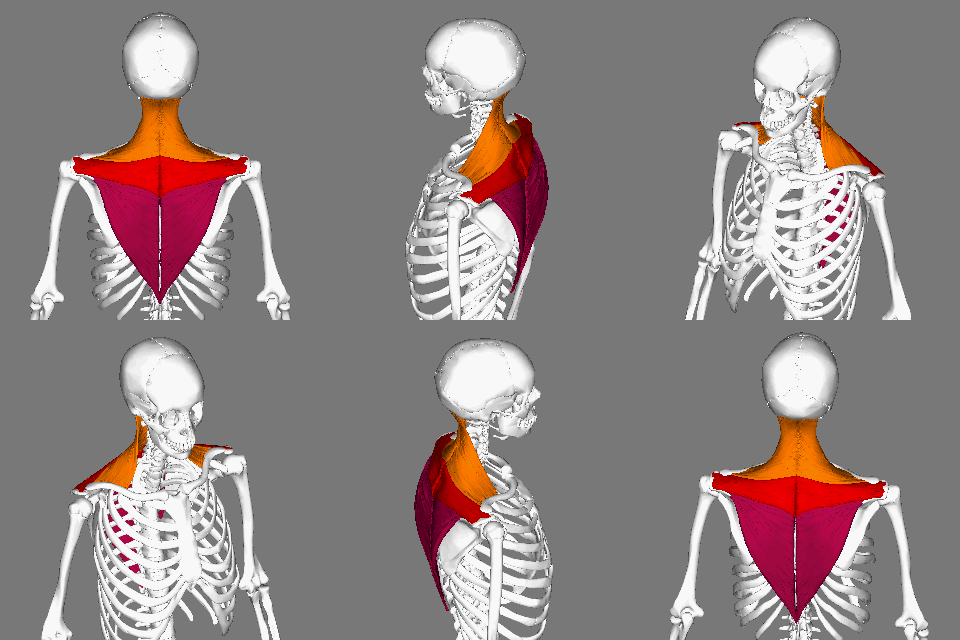
Anatomical structure and regions
The trapezius is usually described in three functional regions: superior (descending), middle (transverse) and inferior (ascending). Its proximal attachments include the occipital bone, the external occipital protuberance, the ligamentum nuchae and the spinous processes of the upper thoracic vertebrae. Distally it inserts along the lateral third of the clavicle, the acromion and the spine of the scapula. Because it lies near the surface it is visible and palpable in many people when contracting.
The trapezius is a major superficial muscle of the back and shoulder complex; it overlies deeper muscles and connects the upper limb to the axial skeleton. In many descriptions of the muscular system it is grouped with other superficial back muscles because of its location and functional relationships.
Innervation, blood supply and biomechanics
Motor innervation is principally via the accessory nerve (cranial nerve XI), with proprioceptive fibers from the cervical plexus (C3–C4). Blood supply typically includes branches such as the transverse cervical artery and tributaries from adjacent vessels. Functionally, the three regions contribute different actions: the upper fibers elevate and help rotate the scapula, the middle fibers retract the scapula toward the spine, and the lower fibers depress and assist upward rotation. These coordinated actions allow overhead reaching, shrugging and controlled descent of the shoulder.
Functions, common disorders and clinical importance
- Primary actions: elevation, retraction, depression and rotation of the scapula, and stabilization during arm movements.
- Clinical issues: strains, spasms and trigger points are common, often related to poor posture, repetitive work or nerve injury; accessory nerve damage can cause shoulder droop and weakness.
- Assessment: physical exam tests include resisted shoulder shrug and palpation for tenderness; imaging or electrodiagnostic studies are used when nerve lesion is suspected.
Rehabilitation emphasizes posture correction, scapular retraction exercises, stretching of tight neck muscles and progressive strengthening of the three functional regions. Simple exercises such as shoulder shrugs, prone rows and scapular squeezes can be effective when applied appropriately.
Historically, the name "trapezius" derives from a Greek/Latin root referring to a small table or trapezoid shape, reflecting the muscle's roughly quadrilateral outline. Anatomical descriptions have been refined over centuries, but the clinical significance of the trapezius — in posture, shoulder mechanics and neurological assessment — remains a constant focus in musculoskeletal medicine and physical therapy. For more general reference see anatomy summaries and clinical resources: spinal and musculoskeletal overviews.
Questions and answers
Q: What is the trapezius muscle?
A: The trapezius muscle is a large muscle that extends longitudinally on the upper portion of a human spine.
Q: What are the functions of the trapezius muscle?
A: The functions of the trapezius muscle are to move the scapulae and support the arm.
Q: How many functional regions does the trapezius muscle have?
A: The trapezius muscle has three functional regions.
Q: What is the superior region of the trapezius muscle responsible for?
A: The superior region of the trapezius muscle supports the weight of the arm.
Q: What is the intermediate region of the trapezius muscle responsible for?
A: The intermediate region of the trapezius muscle retracts the scapulae.
Q: What is the inferior region of the trapezius muscle responsible for?
A: The inferior region of the trapezius muscle rotates and depresses the scapulae.
Q: Where is the trapezius muscle located?
A: The trapezius muscle is located on the upper portion of the human spine.
Related articles
Author
AlegsaOnline.com Trapezius muscle — anatomy, function, and clinical relevance Leandro Alegsa
URL: https://en.alegsaonline.com/art/101218