
Transformer (electrical device)
An electrical device that transfers energy between circuits by electromagnetic induction, used to change alternating voltage levels for power transmission, distribution, measurement and electronics.
A transformer is an electrical device that transfers electrical energy from one electrical circuit to another by means of electromagnetic induction, normally without changing the signal frequency. It is central to modern alternating-current systems and appears in sizes ranging from tiny coupling units found inside a stage microphone to very large grid transformers rated for hundreds of megavolt-amperes. The basic purpose of a transformer is to convert power at one voltage level to another, allowing efficient long-distance transmission at high voltages and safe local use at lower voltages.
Image gallery
10 Images
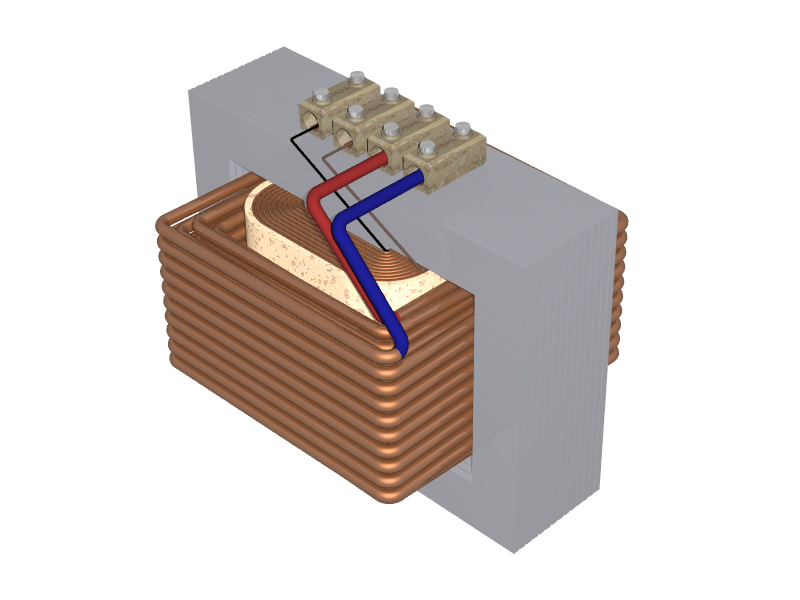


Basic principles and components
Most transformers consist of two or more wire windings (coils) wrapped around a magnetic core. The winding connected to the source is called the primary; the winding that delivers energy to the load is the secondary. For ideal windings, the ratio of voltages equals the ratio of turns: Vp/Vs = Np/Ns, and the currents are inversely related so that power is conserved (neglecting losses). Transformers operate only with alternating current or time-varying signals, because a changing magnetic flux is required to induce voltage in the secondary.
- Core: laminated iron, ferrite or toroidal cores guide magnetic flux and reduce losses.
- Windings: copper or aluminum conductor turns form the primary and secondary coils.
- Insulation and cooling: paper, oil, or resin are common; cooling can be natural or forced to remove heat from losses.
Energy transfer relies on electromagnetism, not a direct electrical connection, so transformers can provide electrical isolation as well as voltage conversion. Because they do not change frequency, equipment connected through a transformer operates at the same cycle rate as the supply.
Types and common uses
Transformers are classified by function and construction. Typical categories include step-up and step-down units for changing distribution voltages; isolation transformers used for safety and noise reduction; autotransformers that use a shared winding to save materials; and instrument transformers (current and potential transformers) used for measurement and protection in power systems. In neighborhoods, pole-mounted and pad-mounted distribution transformers step down medium-voltage lines (for example, systems that drop from several kilovolts to domestic voltages such as 220–240 V or in some countries about 120 V) to feed homes and businesses, powering appliances like refrigerators.
Smaller transformers inside electronics provide required lower voltages, impedance matching, or isolation for different circuit blocks. Large power transformers in substations are vital components of transmission networks, enabling long-distance delivery of electric power with reduced losses by stepping voltage up and later down for local distribution.
Performance, losses and limitations
Real transformers are not lossless: they exhibit copper losses in windings, iron (core) losses from hysteresis and eddy currents, and additional losses from leakage flux and stray effects. Efficiency of large grid transformers can exceed 98–99%, while small or specialized units typically show lower efficiencies. Transformers cannot increase total delivered power; when voltage is raised, current falls proportionally and vice versa, consistent with conservation of energy, so the product of voltage and current (minus losses) remains the same. They also cannot be used with steady direct current because a constant magnetic flux does not induce a secondary voltage.
Historical notes and notable facts
The principles behind transformers follow from the discovery of electromagnetic induction in the early 19th century. Practical transformer designs and the adoption of alternating-current distribution developed in the late 19th century as part of expanding electrical networks; multiple inventors and companies contributed to their refinement. Today, transformers remain indispensable in power engineering, electronics, audio systems, industrial drives and measurement equipment, and are available in numerous specialized forms to meet voltage, power, safety and frequency requirements.
For further technical details, comparisons, or application notes, see introductory resources on voltage conversion, circuit design and power distribution: electrical energy, electrical circuit, electromagnetic induction, frequency, stage microphone, voltage, alternating current, electromagnetism, refrigerators, power, current, electronics.
Questions and answers
Q: What is a transformer?
A: A transformer is a device that transfers electrical energy from one electrical circuit to another through mutual (electromagnetic induction) and without change in frequency.
Q: What is the main reason to use a transformer?
A: The main reason to use a transformer is to make power of one voltage level into power of another voltage level.
Q: How do transformers transfer energy?
A: Transformers transfer energy from the primary coil or input coil, which is connected to supply side, to the secondary coil which supplies power to load, by electromagnetism.
Q: Where are transformers used in power grids?
A: In power grids many transformers are used for delivering electricity from the generator and to the user.
Q: How does a transformer adjust voltage levels for homes and businesses?
A: The transformers in neighborhoods, on electricity poles, or those connected to underground wires usually transform high voltage of 7,200 volts into 220-240 volts of electricity for powering lights and appliances such as refrigerators in homes and businesses. Some countries may use different voltages such as 120 volts.
Q: Can transformers increase power?
A: No, transformers cannot increase power; if the voltage is raised then the current will be proportionally lowered while if the voltage is lowered then the current will be proportionally increased.
Q: What are some basic types of transformers?
A: There are several basic types of transformers including coupling transformer inside stage microphones, big units that carry hundreds of MVA used in power grids, and those found inside electronics equipment providing different kinds of electricity needed by various parts.
Related articles
Author
AlegsaOnline.com Transformer (electrical device) Leandro Alegsa
URL: https://en.alegsaonline.com/art/101150
Sources
- books.google.com : Handbook of Transformer Design and Applications
- books.google.com : Networks of Power: Electrification in Western Society, 1880-1930
- micro.magnet.fsu.edu : "Transformer"
- energyquest.ca.gov : "How does a transformer work?"
- hyperphysics.phy-astr.gsu.edu : "Transformer"
- commons.wikimedia.org : Transformers