
Transcontinental Railroad (United States)
19th-century rail link connecting the U.S. Atlantic and Pacific coasts, completed in 1869. A landmark engineering project that reshaped transport, commerce, settlement, and labor in North America.
The Transcontinental Railroad was the first continuous rail connection across the continental United States. Initiated during the American Civil War after President Abraham Lincoln approved federal legislation, the project aimed to join the nation’s eastern rail network with lines reaching the Pacific Coast. The undertaking accelerated during and after the Civil War era (American Civil War) and became a defining infrastructure achievement of the 19th century.
Image gallery
6 Images



Route and companies
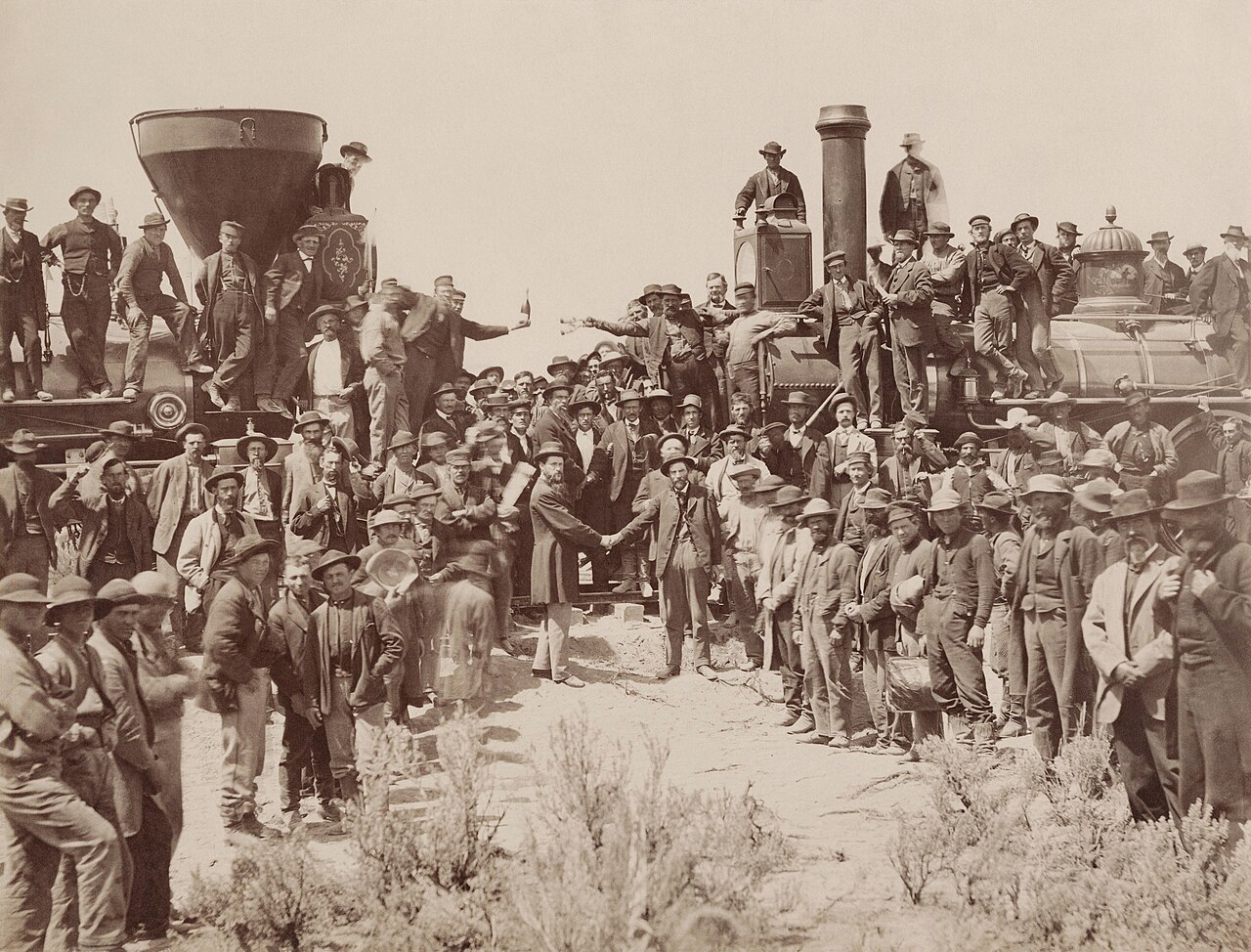
Construction was carried out primarily by two companies working toward a meeting point: the Central Pacific built eastward from Sacramento, California, while the Union Pacific built westward from Omaha, Nebraska. Track-laying crews, supply lines, and engineering teams advanced from both ends across varied terrain. The two lines were joined at Promontory Summit, Utah Territory, on May 10, 1869, in a ceremony that came to symbolize the physical unification of the continent.
Labor, engineering and challenges
The work required massive labor forces and confronted steep natural obstacles: the Sierra Nevada and Rocky Mountains required cuts, fills, bridges, and tunnels; desert stretches demanded water and supply logistics; winter storms and rockslides posed ongoing hazards. Much of the Central Pacific’s workforce consisted of Chinese immigrants; Irish laborers and Civil War veterans were prominent on the Union Pacific side. Workers endured dangerous conditions, long hours, and high mortality from accidents, exposure, and disease.
Completion and public ceremony
When the rails met at Promontory Summit, crews drove ceremonial spikes to mark completion; the occasion is often referred to by the popular term "Golden Spike" used symbolically for the final links. The finished connection dramatically shortened cross‑country travel time and enabled freight movement that had previously been arduous, seasonal, or routed by long sea and overland journeys.
Importance and lasting effects
- Transportation: The railroad reduced travel time between coasts from months to days and established a faster, more reliable national freight corridor.
- Economic development: It stimulated commerce, lowered shipping costs, and opened markets for agricultural and manufactured goods.
- Settlement and transformation: The line encouraged migration, settlement of the interior, and the rapid development of towns along the route.
- Social and cultural impact: The project reshaped Indigenous territories and lifeways and raised complex questions about federal land policy, labor practices, and corporate power.
- Timekeeping and standards: The need to coordinate schedules across long distances helped prompt wider adoption of standardized time and scheduling practices.
Notable facts and distinctions
At the time of its completion the railroad was among the most ambitious engineering projects of its day and one of the longest continuous rail lines in the world. Funding and land grants from Congress played a central role, and the project’s financing and political relationships later became the subject of controversy and investigation. Over subsequent decades the original route was supplemented and rerouted in places, yet the 1869 transcontinental connection remains a landmark event in U.S. infrastructure history and a symbol of industrial-era expansion and its complex consequences.
For further reading and primary documents related to the law that authorized federal support and to the period context, see materials associated with the Pacific Railroad legislation and Civil War-era transportation policy.
Questions and answers
Q: What is the Transcontinental Railroad?
A: The Transcontinental Railroad is a railroad built across the United States of America, connecting the East and the West.
Q: When did the building of the Transcontinental Railroad start?
A: The building of the Transcontinental Railroad started when Abraham Lincoln signed the Pacific Railroad Act of 1862 into law during the American Civil War.
Q: Who built much of the Transcontinental Railroad?
A: The Central Pacific Railroad, building east from Sacramento, California, and the Union Pacific Railroad building West from Omaha, Nebraska, built much of the Transcontinental Railroad.
Q: Where did the two railroads meet to complete the Transcontinental Railroad?
A: The two railroads met at Promontory Summit, Utah, in the year 1869 to complete the Transcontinental Railroad.
Q: Who were the people who built much of the Transcontinental Railroad?
A: Much of the Transcontinental Railroad was built by people who came to the U.S. from China and Ireland.
Q: How did the Transcontinental Railroad change the way of travel across the United States?
A: The Transcontinental Railroad cut the time to go across the United States from months to weeks and later days, making travel easier and faster.
Q: What was the significance of the completion of the Transcontinental Railroad?
A: At the time of its completion in 1869, the Transcontinental Railroad was one of the longest railroads in the world and connected the East and the West of the United States, bringing significant changes to transportation and commerce.
Related articles
Author
AlegsaOnline.com Transcontinental Railroad (United States) Leandro Alegsa
URL: https://en.alegsaonline.com/art/101133