
Trading Places (1983) — comedy satire directed by John Landis
A concise encyclopedia article on Trading Places (1983): overview, cast, themes, production context and lasting influence of John Landis's social-satire comedy starring Dan Aykroyd and Eddie Murphy.
Trading Places is a 1983 American comedy film built around a satirical premise. The film lampoons social class and the mechanics of wealth, and is frequently described as a sharp satire with broad comic elements. It was released under the direction of John Landis, a filmmaker known for mixing genre and humor, and is part of his early 1980s output as director.
Image gallery
9 Images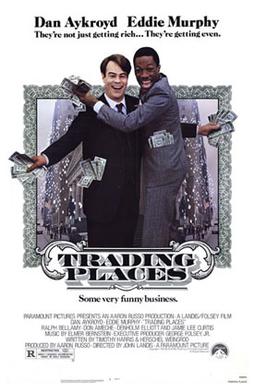






Setting and premise
The story unfolds in urban American settings, notably in Philadelphia and New York City. At its center is a contrived social experiment: two wealthy brokers orchestrate a bet that swaps the lives of a streetwise man and a successful commodities trader. The plot explores how environment and opportunity shape behavior through role reversal and mistaken expectations.
Principal cast and characters
- Dan Aykroyd — plays the privileged professional whose life is upended.
- Eddie Murphy — portrays the resourceful street hustler who is thrust into high society.
- Ralph Bellamy — appears as one of the older, moneyed figures behind the wager.
- Don Ameche — co-stars as a partner in the brokerage world.
- Denholm Elliott — features as a sympathetic character within the business milieu.
- Jamie Lee Curtis — plays a supporting role that adds to the film's romantic and comedic threads.
The screenplay combines slapstick set pieces, sharp dialogue, and situational irony. Much of the humor depends on the contrast between the protagonists' manners and the environments they are forced to navigate. The film balances broad comedy with pointed observations about privilege, greed, and the fragility of social status.
Themes, reception, and legacy
Upon release the picture was both commercially popular and influential: it boosted the career of its young star and contributed to the 1980s trend of buddy comedies that mix social commentary with mainstream appeal. Critics and audiences noted its energetic performances and satirical edge, even as some regarded certain jokes as products of their time. Today it is often discussed for its role in launching Eddie Murphy's rise to stardom and for its example of genre blending in late 20th-century American comedy.
Notable facts include the film's use of financial-market plot devices as comic tools, its ensemble cast, and its continuing presence in discussions about class in popular cinema. For further detail on cast biographies, production notes, and cultural analysis, consult specialized film histories and archival interviews about the film or summaries maintained by major film reference sites and reviews.
Questions and answers
Q: What is Trading Places?
A: Trading Places is a comedy movie that was released in 1983.
Q: Who directed the movie Trading Places?
A: The movie was directed by John Landis.
Q: Where is Trading Places set?
A: The movie is set in Philadelphia and New York City.
Q: Who are some of the actors in Trading Places?
A: Some of the actors in the movie include Dan Aykroyd, Eddie Murphy, Ralph Bellamy, Don Ameche, Denholm Elliott, and Jamie Lee Curtis.
Q: What genre is Trading Places?
A: Trading Places is a comedy movie.
Q: When was Trading Places released?
A: Trading Places was released in 1983.
Q: What is the plot of Trading Places?
A: The plot of Trading Places revolves around a social experiment where two men from different backgrounds, a wealthy businessman and a homeless street hustler, switch lives and roles resulting in comedic situations.
Related articles
Author
AlegsaOnline.com Trading Places (1983) — comedy satire directed by John Landis Leandro Alegsa
URL: https://en.alegsaonline.com/art/101027