
Tower Bridge — design, history, and visitor information
Victorian bascule and suspension bridge in London spanning the River Thames near the Tower of London; notable for its twin towers, raising bascules, exhibition and vantage walkways.
Overview
Tower Bridge is a prominent crossing of the River Thames in central London, located beside the historic Tower of London. Its geographic position is commonly given as 51°30′20″N 0°04′32″W. Completed in the late 19th century, the structure combines a suspension bridge with a pair of moveable road spans, or bascules, so that ships can pass through the central opening while road traffic and pedestrians are carried across when the deck is lowered.
Image gallery
10 Images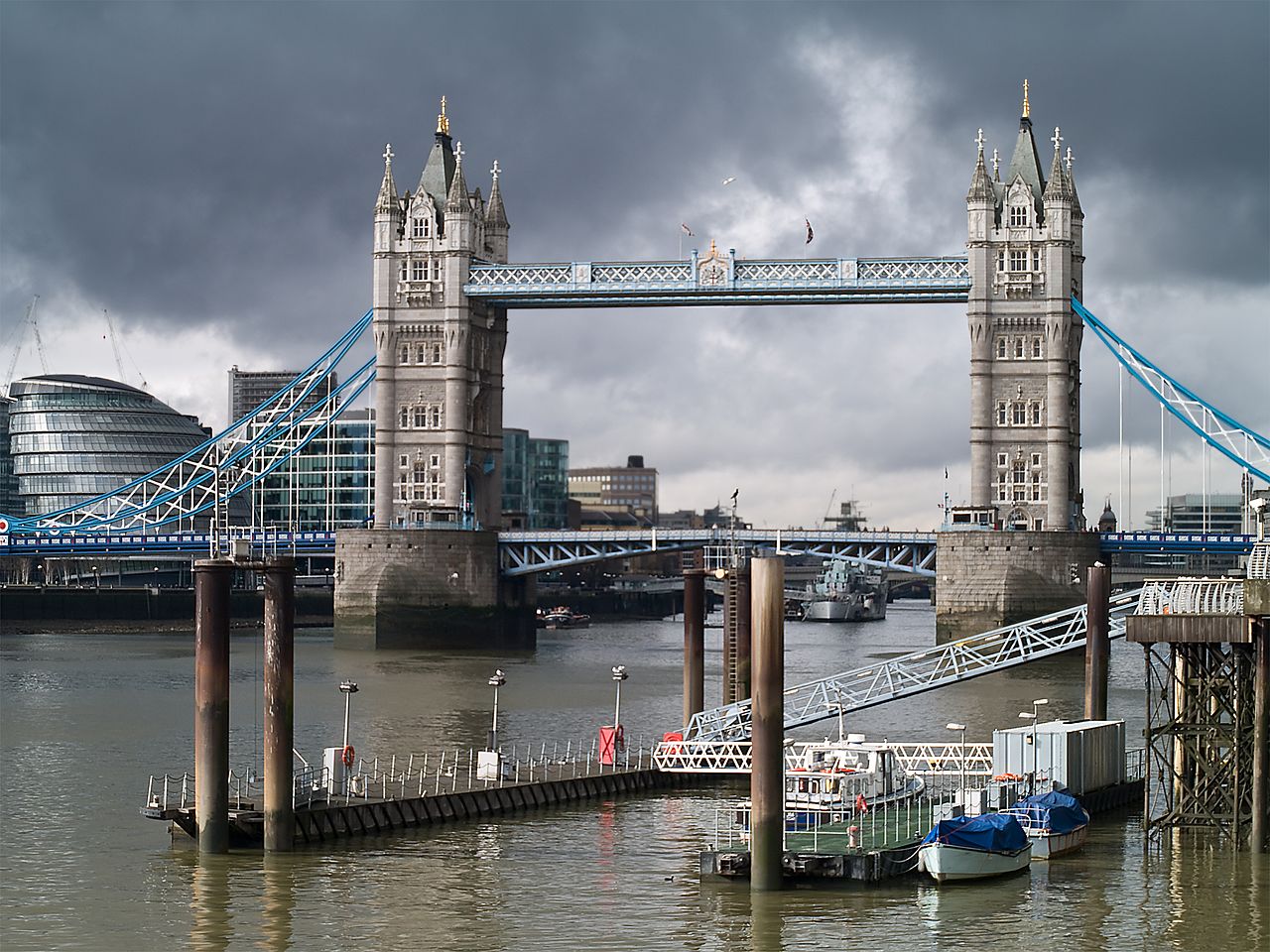


Design and main components
The bridge is recognisable for its two massive masonry-clad towers linked by high-level walkways and the central twin bascules. The bascules form the movable part of the deck; when raised they create a clear navigation channel. The towers contain the pivots, machinery and supporting steel work that make the lifting operation possible. Externally the structure is clad in stone to harmonise with nearby landmarks, while its internal frame is built from steel.
Operation, openings and technical features
Tower Bridge operates as a drawbridge in that its bascules can be raised to allow tall vessels to pass on the River Thames. The movable spans can be lifted to a steep angle — commonly reported as up to 83 degrees — to provide clearance for shipping and river traffic; see additional technical notes at lift angle and operation. The bridge continues to open frequently for river traffic, with openings measured in the hundreds each year to accommodate commercial and leisure craft.
- Bascules: two counterbalanced leaves forming the roadway centre.
- Towers: house machinery and pedestrian access to the upper walkways.
- Walkways: high-level galleries that originally linked the towers and now form part of a visitor route and exhibition space.
History and construction
The idea for a modern river crossing near the Tower of London emerged in the Victorian era to meet increasing traffic and navigation needs. The bridge was designed through a collaboration of architect and civil engineer, and built in the final decades of the 1800s. Its structure and appearance reflect Victorian engineering and an intent to present a grand civic landmark beside the fortress of the Tower. During the 20th century the bridge’s functions evolved: vehicular usage patterns, maintenance technologies and public access have all changed while the bridge itself remained a working river crossing.
Visitor experience and uses
Tower Bridge is a major visitor attraction as well as an active piece of road and river infrastructure. An exhibition inside the upper walkways explains the bridge’s engineering and history and offers panoramic views across the city; these walkways also provide one of the widely cited vantage points in central London. Tourists and locals alike use the crossing for everyday travel and for events when the bascules are opened to permit tall vessels. The south approach leads down toward Bermondsey in the borough of Southwark, while the north landing serves Tower Hill and adjacent historic sites.
Distinctions and notable facts
Because of its dramatic twin towers and raised road leaves, Tower Bridge is frequently mistaken for the neighbouring London Bridge, a simpler crossing located upstream. Tower Bridge remains one of the most photographed and visited structures in London, balancing heritage presentation with continuing operational duties as a moveable crossing on one of the United Kingdom’s busiest rivers. For further technical details or visitor planning consult official resources and local heritage information provided by municipal authorities and the bridge’s custodians at coordinates and directions.
Questions and answers
Q: What are the coordinates of Tower Bridge?
A: The coordinates of Tower Bridge are 51°30′20″N 0°04′32″W / 51.50556°N 0.07556°W / 51.50556; -0.07556.
Q: Where is Tower Bridge located?
A: Tower Bridge is located near the Tower of London, crossing the River Thames with one side in Tower Hill and the other in Bermondsey, an area in Southwark.
Q: How often does the bridge deck need to be raised?
A: The bridge deck needs to be raised about 900 times per year to allow tall ships to pass through.
Q: What angle can the bascules be raised to?
A: The bascules can be raised up to 83o from the horizontal.
Q: Why do tourists come to London?
A: Tourists come to London specifically to see Tower Bridge as it is far more visible than London Bridge which people often mistake it for.
Q: Is there an exhibition centre on or near Tower Bridge?
A: Yes, there is an exhibition centre located in the horizontal walkway of Tower Bridge which offers one of the best vantage points in London for visitors.
Q: What type of bridge is Tower Bridge?
A: Tower Bridge is a drawbridge that allows ships through when its deck (bascule) is raised at an angle in the centre.
Related articles
Author
AlegsaOnline.com Tower Bridge — design, history, and visitor information Leandro Alegsa
URL: https://en.alegsaonline.com/art/100916
Sources
- towerbridge.org.uk : "Tower Bridge Exhibition"
- www1.thamesdiamondjubileepageant.org : Key facts
- londontown.com : "Thames Jubilee Pageant,"
- worldcat.org : 1352-7991