
Beelzebufo — the extinct giant frog (the “Devil Toad”)
Beelzebufo, nicknamed the Devil Toad, is an extinct giant frog from Late Cretaceous Madagascar, known for its unusually large size, robust skull, and debated relationships to modern horned frogs.
Overview
Beelzebufo is an extinct genus of large frog that lived in what is now Madagascar during the Late Cretaceous, roughly seventy million years ago. Popular media dubbed it the "Devil Toad" or "Frog From Hell" because of its impressive size and heavy build. It is represented by the species commonly referred to in literature and public accounts and is notable for being among the largest frogs known from the fossil record.
Image gallery
3 Images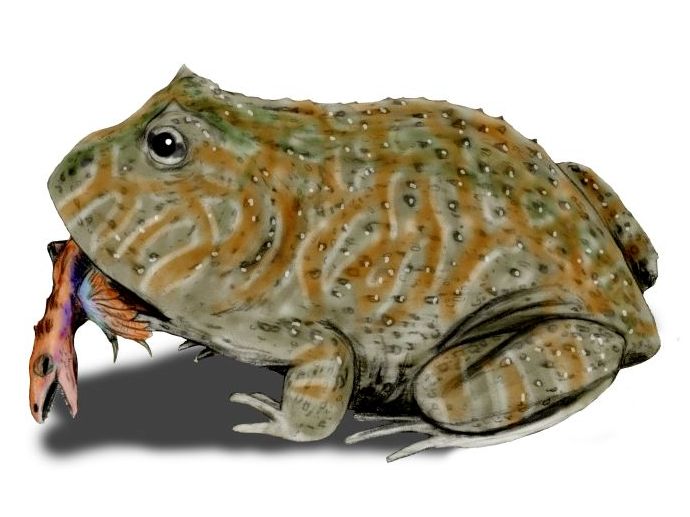


Anatomy and notable traits
Fossil material attributed to Beelzebufo includes skull bones and elements of the postcranial skeleton that reveal a broad, heavily ossified skull and stout jaws. Estimates based on these remains suggest a body (snout–vent) length approaching 40–41 cm (about 16 inches) and a mass on the order of 4–5 kg (about 9–11 lb), making it substantially larger than any living frog. Its skull shows bony ornamentation and a short, wide shape similar in some respects to modern horned or pacman frogs, hinting at a powerful bite.
Discovery and age
Fossils of Beelzebufo were recovered from Late Cretaceous deposits in Madagascar. The geological context places the animal near the end of the age of dinosaurs, and the remains have been studied to reconstruct its size, anatomy and relationships. For further summaries and specimen reports see field summaries and descriptive accounts at scientific outlets such as research summaries.
Ecology and behavior (inferred)
Based on its robust skull and inferred musculature, paleontologists suggest Beelzebufo was an ambush predator that fed on a variety of prey items available in its environment. Its diet may have included insects, other amphibians, small reptiles and possibly small vertebrates. Reconstructions compare its likely feeding strategy to that of extant ambush frogs, which use a sudden, powerful jaw closure to capture prey.
Scientific significance and debate
Beelzebufo has been of particular interest to researchers studying Gondwanan biogeography and frog evolution because some anatomical features resemble those of South American horned frogs. This similarity has prompted discussion about ancient faunal connections between Madagascar and other southern continents, though the precise phylogenetic placement of Beelzebufo remains debated. Readers can consult museum pages and reviews for more discussion at museum resources and compilations of vertebrate paleontology literature at review collections.
- Common name: Devil Toad (media nickname).
- Time: Late Cretaceous (approximately 70 million years ago).
- Size: about 40–41 cm snout–vent length; roughly 4–5 kg estimated mass.
- Significance: largest known fossil frog; important for studies of southern hemisphere faunal links.
While popular reconstructions sometimes exaggerate its capacity to consume large prey, scientific accounts treat such ideas cautiously. Beelzebufo remains a striking example of how diverse amphibian body plans became in deep time and continues to inform discussions about ancient ecosystems on Madagascar.
Questions and answers
Q: What is Beelzebufo?
A: Beelzebufo is a large frog discovered in the Upper Cretaceous of Madagascar.
Q: What were some of the nicknames for Beelzebufo?
A: The media called Beelzebufo 'Devil Toad' and 'The Frog From Hell'.
Q: How long ago did Beelzebufo live?
A: Beelzebufo lived some 70 million years ago.
Q: How large was Beelzebufo?
A: Beelzebufo had a body length of about 16 inches (40.5 cm), making it larger than any living frog. Its weight in life was about 9-10 lbs (4.5 kg).
Q: Where was Beelzebufo discovered?
A: Beelzebufo was discovered in the Upper Cretaceous of Madagascar.
Q: What makes Beelzebufo unique compared to other frogs?
A: Beelzebufo is unique due to its large size; it is larger than any living frog.
Q: What is the significance of Beelzebufo's discovery?
A: Beelzebufo's discovery provides insight into the diversity of ancient amphibians and their evolution over time.
Related articles
Author
AlegsaOnline.com Beelzebufo — the extinct giant frog (the “Devil Toad”) Leandro Alegsa
URL: https://en.alegsaonline.com/art/10082
Sources
- ncbi.nlm.nih.gov : "A giant frog with South American affinities from the late Cretaceous of Madagascar"
- doi.org : 10.1073/pnas.0707599105
- pubmed.ncbi.nlm.nih.gov : 18287076
- news.bbc.co.uk : "'Frog from hell' fossil unearthed"
- animals.nationalgeographic.com : "Devil Frogs, Devil Frog Pictures, Devil Frog Facts"