
Tornado Alley — region, causes, history and evolving risk
Overview of Tornado Alley: common definitions, meteorological causes, notable outbreaks including 1974, regional variations like Dixie Alley, and recent shifts in tornado frequency.
Overview
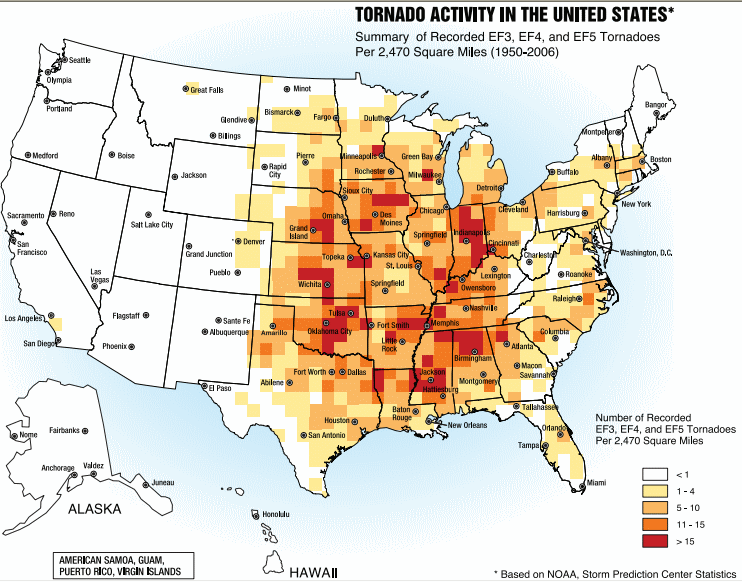
Tornado Alley is an informal term used to describe a region of the central United States where tornadoes occur more frequently than in many other parts of the country. The exact boundaries are not fixed: some definitions emphasize overall tornado counts, others the rate of strong tornadoes (EF2–EF5). Typical maps place Tornado Alley across portions of the Great Plains and the Midwest, but the phrase functions more as a climatological shorthand than a strict administrative region. For general geographic context see United States and for the basic meteorological phenomenon see tornadoes.
Image gallery
5 Images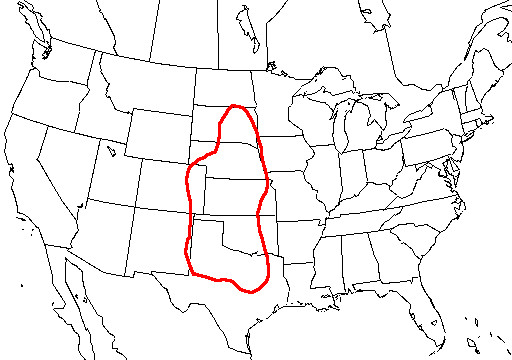


Causes and characteristic features
Tornado Alley’s higher tornado frequency results from a recurring clash of air masses. Warm, moist air from the Gulf of Mexico flows northward and meets cool, dry air from the Rocky Mountains and Canada. The presence of the jet stream aloft supplies wind shear, which can organize rotating thunderstorms. The region’s broad, relatively flat terrain allows these air patterns to interact over long distances, favoring the development of supercells — storms that most commonly produce the strongest tornadoes. Measurement of tornado strength uses the Enhanced Fujita (EF) scale based on post-event damage assessment.
History and notable outbreaks
Historical records show many large outbreaks have affected what is popularly called Tornado Alley. Among the most significant is the 1974 Super Outbreak, which produced more than a hundred tornadoes across many states. That event included tornadoes affecting Illinois, Indiana, Kentucky, Michigan, Mississippi, North Carolina, Ohio, South Carolina, Tennessee, Virginia, and West Virginia. Such outbreaks illustrate that significant tornado activity is not confined to a single state or neat polygon.
Regional variations and shifting patterns
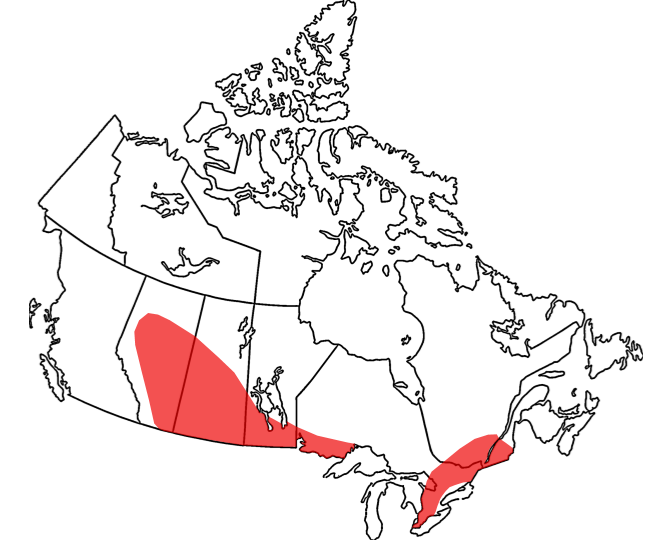
Different parts of the central and eastern U.S. show distinct tornado behavior. States often included in broader definitions of Tornado Alley are Minnesota, Wisconsin, Illinois and others in the Midwest. A separate high-risk area, sometimes called "Dixie Alley," covers parts of the Southeast where tornadoes tend to be more nocturnal and occur in more densely vegetated, populated terrain — factors that increase danger. Recent climatological analyses indicate a tendency for tornado frequency and notable events to shift somewhat eastward and northward from the traditional core, increasing activity across the northern Plains and parts of the Midwest and Canadian prairie regions. Scientists continue to study the role of changing atmospheric patterns in these trends.
Importance, impact and preparedness
Tornado Alley is important for emergency planning, building codes, and public awareness campaigns. Local and national agencies operate warning systems, storm-spotter networks, and forecasting centers to reduce loss of life and property. Preparedness measures commonly advised include safe-room construction, clear communication of watch/warning distinctions, and community shelters in vulnerable areas. Enhanced mapping of tornado climatology informs insurers, city planners, and homeowners about relative risk.
Distinctions and notable facts
- There is no single authoritative boundary for Tornado Alley; maps vary depending on whether they emphasize total tornado count, tornado density, or frequency of violent tornadoes.
- Severe outbreaks can and do occur outside the traditional Alley, as demonstrated in historic events spanning the eastern U.S.
- Research continues into seasonal timing, nocturnal occurrence, and possible influences from large-scale climate variability.
Further reading: introductory materials and regional climatologies can provide updated maps and trend analyses for those who want to explore how the concept of Tornado Alley is used by meteorologists, planners, and the public.
Questions and answers
Q: What is Tornado Alley?
A: Tornado Alley is a colloquial term used to describe an area of the United States which sees more tornadoes than other parts of the country. It typically includes states like Minnesota, Wisconsin, Illinois, Indiana and Ohio.
Q: Where did the 1974 super tornado outbreak occur?
A: The 1974 super tornado outbreak occurred in Georgia, Illinois, Indiana, Kentucky, Michigan, Mississippi, North Carolina, Ohio, South Carolina, Tennessee Virginia and West Virginia.
Q: Are tornadoes happening more often in the northern parts of Tornado Alley?
A: Research suggests that tornadoes are occurring more frequently in the northern parts of Tornado Alley where it reaches into the Canadian prairies.
Related articles
Author
AlegsaOnline.com Tornado Alley — region, causes, history and evolving risk Leandro Alegsa
URL: https://en.alegsaonline.com/art/100695
Sources
- glossary.ametsoc.org : Glossary of Meteorology · web.archive.org
- si.edu : "Tornado Alley"
- usask.ca : "Archived copy"
- nssl.noaa.gov : "Severe Weather 101: Tornado FAQ" · web.archive.org
- spc.noaa.gov : "Tornado FAQ" · web.archive.org
- nssl.noaa.gov : "Climatology Risk of Strong and Violent Tornadoes In the United States" · web.archive.org
- fema.gov : Taking Shelter from the Storm: Building a Safe Room for Your Home or Small Business
- essaytornado.com : "Essay Tornado"