
Titanoboa cerrejonensis — the giant Paleocene snake
Titanoboa cerrejonensis, an extinct giant boa-like snake from about 58 million years ago, is the largest known snake. Fossils from Colombia reveal its size, habitat, diet, and significance for Paleocene climates and ecosystems.
Overview
Titanoboa cerrejonensis is an extinct species of giant snake that lived during the Paleocene epoch, roughly 58 million years ago. It is widely described in scientific literature as the largest known snake. Fossil evidence places this species in northern South America and indicates it reached lengths and masses far exceeding those of living boids.
Image gallery
8 Images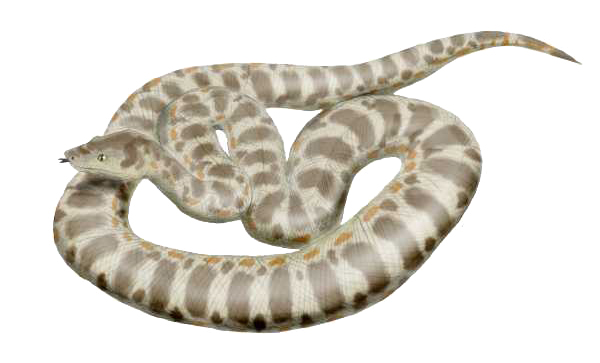


Anatomy and estimated size
Partial skeletons and numerous vertebrae have allowed paleontologists to estimate the overall proportions of Titanoboa. Reconstructions suggest an animal that could exceed 12 metres (about 40 feet) in length and weigh on the order of a metric ton or more; popular summaries often state a mass equivalent to over a ton, though precise weight estimates vary with methodology. Its anatomy places it among the boa-like snakes, closely related in form to modern anacondas and boa constrictors, with a robust body and vertebrae consistent with powerful constriction and ambush predation.
Discovery and geological context
Major fossil finds of Titanoboa come from the Cerrejón Formation in La Guajira, Colombia. The remains were recovered from an open-cast coal mine and associated sediments that preserve a rich assemblage of plants and vertebrates. The locality, excavated in the early 2000s, yielded skull material and many vertebrae; several skulls reported in field accounts date to initial expeditions in 2002. The find site is sometimes described as a coal mine in Colombia, where plant fossils corroborate a warm, wet environment during the time of deposition.
Environment, diet and ecology
Fossil plant assemblages and sediment chemistry from the Cerrejón Formation indicate a dense, tropical rainforest environment rather than open savanna. Paleobotanical evidence suggests a warm, humid climate consistent with a tropical rainforest biome. In this setting Titanoboa likely occupied riverine and swampy habitats and preyed on aquatic and semi-aquatic vertebrates; large crocodyliforms are among the prey items commonly proposed in the scientific discussion, and popular accounts note that it may have eaten crocodiles.
Scientific significance and notable facts
Titanoboa has become a focal point for studies of vertebrate gigantism, Paleocene climates, and post‑Cretaceous ecosystem recovery. Its size supports the inference that tropical temperatures in northern South America were higher in the Paleocene than today, allowing ectothermic animals to attain larger sizes. The discovery included multiple large specimens and skulls, providing unusually complete material for a snake of this antiquity.
Public display and outreach
Life‑size reconstructions and casts of Titanoboa skeletons have been exhibited in museums worldwide. A prominent replica has been displayed at the Smithsonian National Museum of Natural History and was part of a traveling exhibition that introduced the species to a broad public audience; museum materials and news releases highlight the specimen in relation to other large modern snakes and prehistoric fauna. For further collection and exhibit information see institutional summaries and public outreach pages provided by the original research teams and hosting museums (museum display).
- Taxonomy: a giant boid relative.
- Age: Paleocene epoch (~58 million years ago) — see Paleocene and geological context.
- Discovery site: Cerrejón Formation, La Guajira, Colombia (Colombia, coal mine deposits).
- Ecology: tropical rainforest, likely semi-aquatic predator that could take large prey such as crocodyliforms (crocodile prey).
Titanoboa remains one of the most compelling examples of how paleontology, geology, and climatology combine to reconstruct ancient life and environments. The original finds and subsequent research continue to inform debates about physiological limits in reptiles and the climate dynamics of the early Cenozoic.
Questions and answers
Q: What is the Titanoboa cerrejonensis?
A: The Titanoboa cerrejonensis is the largest known snake that is now extinct but was a relative of the anaconda and the boa constrictor.
Q: How big was the Titanoboa cerrejonensis?
A: The Titanoboa cerrejonensis was about 43 feet long and weighed over a ton.
Q: What did the Titanoboa cerrejonensis eat?
A: The Titanoboa cerrejonensis ate crocodiles.
Q: When did the Titanoboa cerrejonensis live?
A: The Titanoboa cerrejonensis lived in the Palaeocene epoch, about 58 million years ago.
Q: Where was the fossil of Titanoboa cerrejonensis found?
A: The fossil of Titanoboa cerrejonensis was found in an open-cast coal mine in Colombia in 2009.
Q: What does the presence of plant fossils at the site suggest?
A: The presence of plant fossils at the site suggests that the climate at the time was a tropical rainforest.
Q: Where can a life-size replica of the Titanoboa cerrejonensis be seen?
A: A life-size replica of the Titanoboa cerrejonensis can be seen at the Smithsonian National Museum of Natural History in Washington D.C. as it was sent on a world tour to be shown at various museums.
Related articles
Author
AlegsaOnline.com Titanoboa cerrejonensis — the giant Paleocene snake Leandro Alegsa
URL: https://en.alegsaonline.com/art/100123
Sources
- nature.com : "Scientists find world's biggest snake"
- nature.com : "Giant boid snake from the paleocene neotropics reveals hotter past equatorial temperatures"
- bbc.co.uk : bbc.co.uk/news/magazine-17544885
- sciencedaily.com : "Science Daily: At 2,500 pounds and 43 feet, prehistoric snake is largest on record"
- sitesarchives.si.edu : "Smithsonian Institution Traveling Exhibition Service - Titanoboa: Monster Snake"