
Tiruchirapalli district
Central district of Tamil Nadu centered on the city of Tiruchirappalli. Covers about 4,404 km² with a population around 2.7 million. Known for the Kaveri river, historic temples, and several major institutions.
Overview
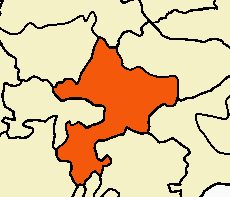
Tiruchirapalli district lies in the heart of the state of Tamil Nadu and is administered from the city of Tiruchirappalli, often called Trichy. The district occupies roughly 4,404 square kilometres and is home to about 2.7 million people. It combines urban centres, agricultural plains irrigated by the Kaveri River, and a number of historically and culturally important sites.
Image gallery
10 Images


Geography and administration
The district is located on the central plains of Tamil Nadu with the Kaveri River and its distributaries shaping local irrigation and agriculture. Terrain ranges from fertile riverine tracts to low rises and rock outcrops in and around the city. Administratively, the district is divided into taluks, municipalities and village panchayats that manage local governance, services and rural development.
History and identity
Tiruchirapalli has a long history: the area was important in early South Indian kingdoms and later figures in medieval and colonial records. The anglicized name Trichinopoly appears in older documents, while Uraiyur and other ancient towns in the region are associated with early Chola rule. Over time the district developed as a trade, religious and administrative centre.
Economy, institutions and culture
The economy mixes agriculture, small and medium industry, education and services. Crops such as paddy, sugarcane and plantain are widely cultivated where Kaveri irrigation is available. The district is also known for engineering and manufacturing units, traditional crafts and food-processing industries. Several notable higher-education and research establishments are based in the district, contributing to its reputation as an educational hub.
Notable places and transport
Key landmarks include the Srirangam island and the Ranganathaswamy Temple, the Rockfort complex, and the historic Kallanai (Grand Anicut) on the Kaveri. The city of Tiruchirappalli serves as a transport hub with a major railway junction and an airport connecting the region to other parts of India. Pilgrimage, tourism and trade bring additional visitors and economic activity.
Distinctive aspects and modern importance
- Religious and cultural significance due to major temples and festival traditions.
- Agricultural productivity supported by Kaveri river irrigation systems.
- Concentration of educational institutions and technical centres that serve central Tamil Nadu.
- Blend of historic urban fabric and rural hinterland that shapes the district’s identity.
Tiruchirapalli district remains an important administrative, cultural and economic area in central Tamil Nadu, balancing heritage sites with contemporary institutions and infrastructure.
Questions and answers
Q: How many districts are there in Tamil Nadu?
A: There are 32 districts in Tamil Nadu.
Q: Which city is the capital of Tiruchirapalli district?
A: Tiruchirappalli is the capital of Tiruchirapalli district.
Q: What is the geographical location of Tiruchirapalli district?
A: Tiruchirapalli district is located along the Kaveri River in the heart region of Tamil Nadu.
Q: What was the old name of Tiruchirapalli district?
A: The old name of Tiruchirapalli district was Trichinopoly.
Q: What is the area of Tiruchirapalli district?
A: The area of Tiruchirapalli district is 4,404 square kilometers.
Q: What is the population of Tiruchirapalli district?
A: The population of Tiruchirapalli district is 27,22,290.
Q: Which is one of the largest cities in Tamil Nadu?
A: Tiruchirappalli is one of the largest cities in Tamil Nadu, which is also the capital of Tiruchirapalli district.
Related articles
Author
AlegsaOnline.com Tiruchirapalli district Leandro Alegsa
URL: https://en.alegsaonline.com/art/100077